syn. Persicaria affinis - Bistorta affinis
syn. Persicaria affinis - Bistorta affinis
Creeping perennial of the Polygonaceae family, native to the Himalayan foothills, from Nepal to northern India and Pakistan, where it colonizes rocky slopes, high-altitude meadows, and trail edges, generally between 3,000 and 4,500 meters.
It forms a dense and spreading carpet, rarely beyond 20 to 25 cm in height when in bloom. The leaves are lanceolate, bright green, leathery, and take on russet to reddish-brown hues in autumn that persist part of the winter, adding prolonged visual interest well beyond the flowering period.
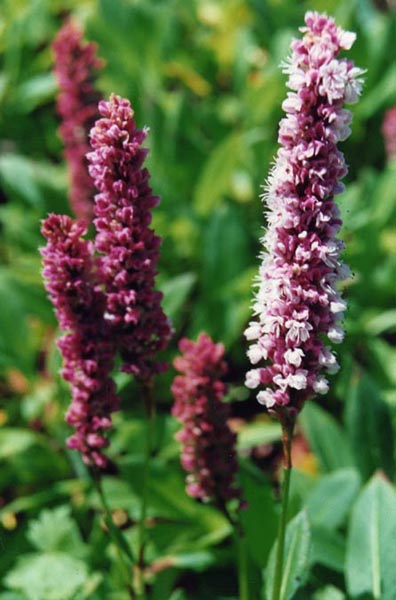
The flowers are tiny, packed in upright, cylindrical, and dense spikes, reaching 5 to 8 cm in length. Their color characteristically evolves during flowering, changing from an almost white pale pink to a deep pink and then to a dark reddish-brown as they age — several shades coexisting simultaneously on the same plant.
In its natural habitat, its flowering extends from July to September. In cultivation under temperate climates, it generally blooms from August to October.
Undemanding, it accepts various soils, moderately drained, in sun or partial shade. Hardy and vigorous, it is suitable for covering slopes, borders, and large rock gardens where its persistent carpet and colorful spikes make a reliable ground cover at the end of the season.