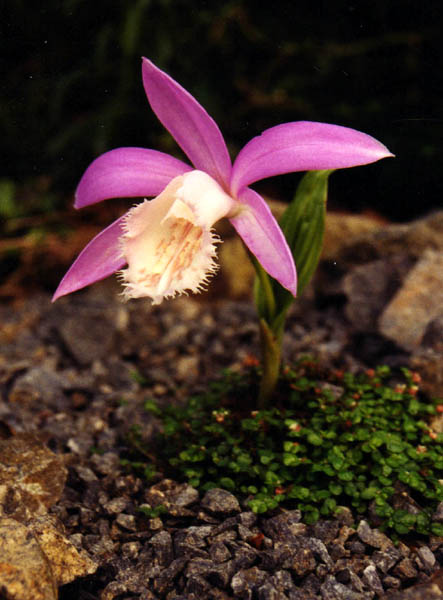
Terrestrial or epilithic orchid of the Orchidaceae family, native to Taiwan and the southeastern coastal provinces of China, where it grows on mossy rocks, shaded forest banks, and moist grassy slopes, at about 1,000 to 2,500 meters. It is one of the most widely cultivated species of the genus in Europe, and the starting point for many horticultural hybrids.
The pseudobulbs, flattened and green to violet in color, remain at ground level and renew each year. The flower, borne on a short solitary stem, blooms before or with the emergence of the single, narrow, pleated leaf. The tepals are lilac-pink to magenta-pink, well spread, giving the flower a distinctly starry appearance. The lip, wider and very ornamental, is cream-white to pale pink, widely fringed on its edges and streaked with brown-ochre inside, forming a marked contrast with the tepals.
In its natural habitat, flowering extends from March to April. In cultivation under temperate climates, it occurs in April-May depending on exposure and winter conditions.
It is cultivated in pots in a well-drained, humus-rich mix, or in the ground in light soil in partial shade. It withstands slightly negative temperatures in dry rest, but fears stagnant moisture in winter. The presence of gravel on the surface is a common practice to ensure drainage at the collar.