Terrestrial or epiphytic orchid of the Orchidaceae family, native to central and southern China, northern Burma, and northern Vietnam, where it grows on mossy rocks, forest slopes, and at the base of trees, between approximately 1,000 and 3,500 meters in altitude. It withstands cold, dry winters and cool, humid summers there.
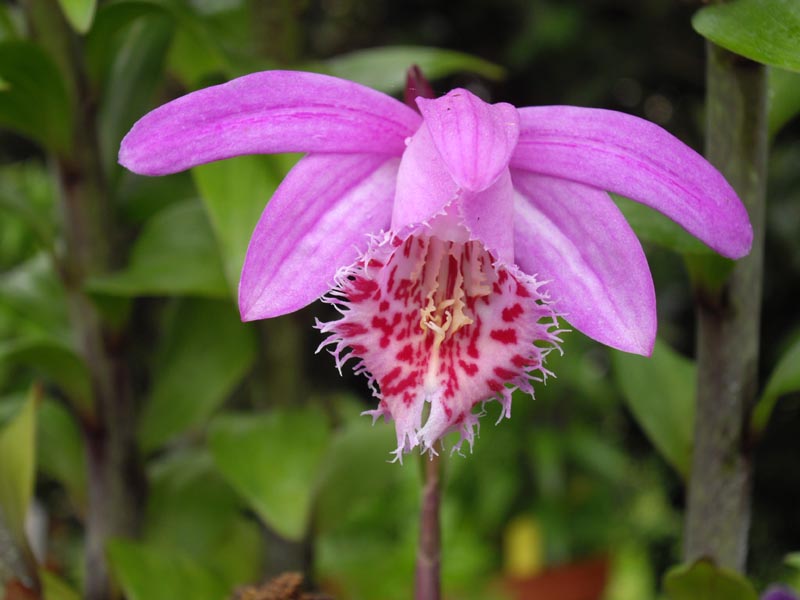
The plant produces small ovoid, flattened pseudobulbs, dark green to purplish, which spend the winter bare and in spring give rise to one or two pleated lanceolate leaves, and one to two solitary flowers borne on a short stem of 10 to 15 cm. The flower is one of the most spectacular of the genus, with five spreading tepals of bright mauve-pink to pink-lilac, and a wider lip, cream-white with a pinkish base, abundantly spotted and streaked with dark crimson red, and edged with a delicately cut white fringe giving it an almost theatrical appearance.
In its natural habitat, flowering extends from March to May, before or simultaneously with the emergence of the leaves. In cultivation under cold shelter or in an alpine house, it generally blooms in March-April.
It is cultivated in pots or in the ground, in well-drained soil rich in organic matter. Contrary to a common misconception, it withstands a wet winter without difficulty as long as drainage is ensured, and tolerates temperatures around -8 to -10°C in complete dormancy. Watering resumes gradually with the appearance of flower buds in spring, with good light but no direct sunlight.