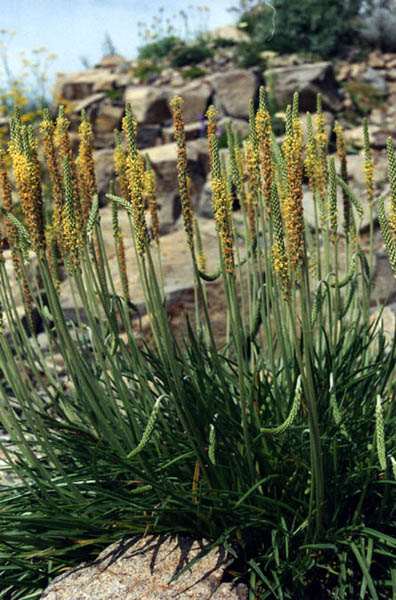
A perennial of the Plantaginaceae family, the sea plantain is widely spread along the Atlantic and Mediterranean coasts of Europe, Asia, and North America, but it is also found at altitude in the Alps and the Pyrenees, on windy lawns and rocks, up to over 2,000 meters. This remarkable ecological range, from coastal salt meadows to mountain summits, demonstrates a great capacity to adapt to harsh conditions.
The plant forms dense, upright clumps, 15 to 30 cm in height when in bloom. The leaves are narrowly linear, dark green, slightly fleshy and grooved, tightly packed in a compact tuft that from a distance resembles certain grasses. This moderate succulence is an adaptation both to the salinity of coastal environments and to the dryness of high-altitude lawns.
The spikes are cylindrical, dense and well-stocked, borne by long, slender, upright stems. At the time of flowering, the bright yellow to yellow-orange anthers clearly protrude from the greenish bracts, giving the entire spike a warm and luminous color that is very recognizable. In its natural habitat, flowering extends from June to September depending on latitude and altitude.
In cultivation, it accepts poor, well-drained, sandy or stony soils, in full sun. Its tolerance to salinity and wind makes it a strong candidate for exposed rock gardens or seaside gardens. It proves hardy and undemanding once established.