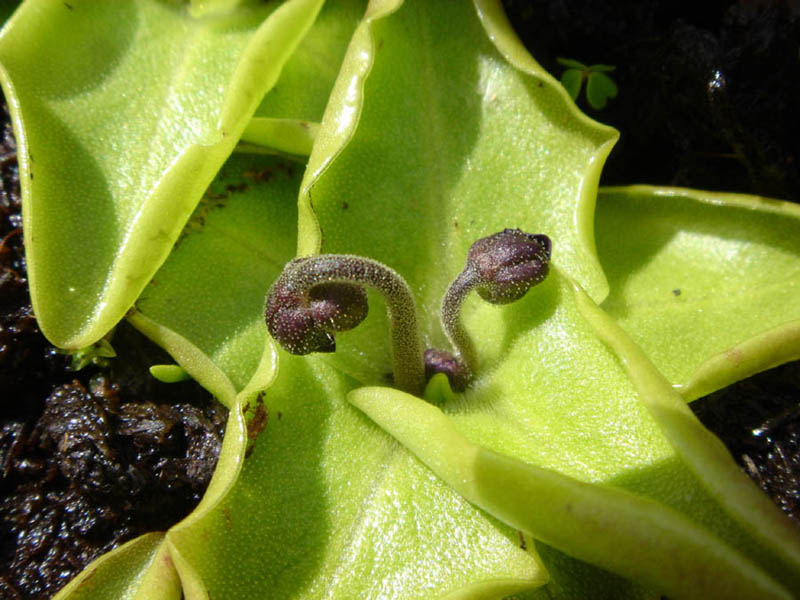
Carnivorous perennial of the Lentibulariaceae family, the large-flowered butterwort is native to the mountains of Western Europe, mainly the Pyrenees, the Western Alps, the Massif Central, and Southwest Ireland, where it constitutes one of its northernmost stations. It colonizes rocky seepages, slope bogs, humid cliffs, and mossy rocks constantly watered, between approximately 800 and 2,500 meters.
The basal rosette is flattened and spread out, formed of fleshy oval leaves, with a characteristic yellow-green color, entirely covered with pedicellate glands secreting a viscous and shiny mucilage. This passive trap captures small insects, springtails, mites, and sometimes filaments of algae or mosses; distinct sessile glands then secrete digestive enzymes that dissolve the prey and allow the absorption of nutrients, thus compensating for the nitrogen-poor environments where it grows. In winter, the plant reduces to a compact and scaly bud, abandoning its carnivorous leaves until the following spring.
The flowers, borne individually on upright stems 8 to 15 cm tall, are of an intense violet-purple, bilabiate, with a velvety white throat and a well-developed spur. They are among the largest of the genus in Europe. In its natural habitat, flowering extends from May to July depending on altitude. In cultivation, it generally blooms from May to June.
It requires a constantly moist, poor, acidic to neutral substrate, without excessive calcareous input, based on peat and coarse sand or pumice. It is cultivated in a container without stagnant water reserve, in bright light without direct burning sun.