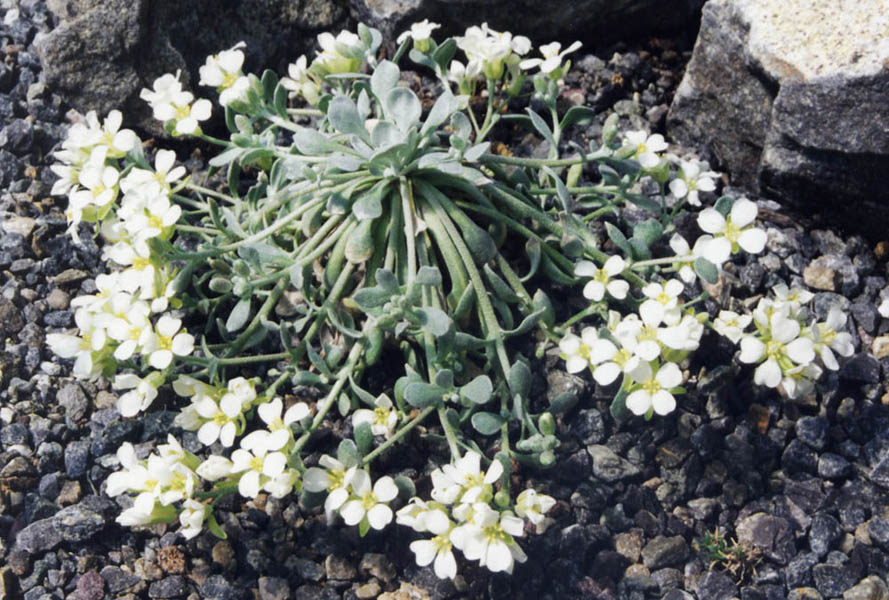
Perennial of the Brassicaceae family, Physaria eburnifolia is a species endemic to the western United States, mainly Wyoming and Colorado. It inhabits rocky slopes, screes, and arid gravelly soils of the montane and subalpine levels, on poor and well-drained substrates.
It forms a low and compact rosette, not exceeding 5 to 8 cm in height in vegetation, from which spread out floral stems radiating in all directions from the center. The leaves are spatulate, gray-green, covered with a silvery stellate indument characteristic of Physaria, giving them a matte and velvety appearance.
The flowers have four petals, cream white to pure white with a slight ivory sheen, borne in small terminal clusters at the end of each radiating stem. The flowering ensemble forms a spread-out crown around the center of the rosette, creating a very distinct effect on the dark gravel. In its natural habitat, its flowering extends from May to July depending on the altitude. In cultivation, it generally blooms in April-May.
It requires full sun, a lean, very well-drained, gravelly-sandy soil, and does not tolerate stagnant moisture, especially in winter. A plant for a cold greenhouse or very well-drained rock garden, it is ideally cultivated in a pot or trough with winter protection against excess moisture.