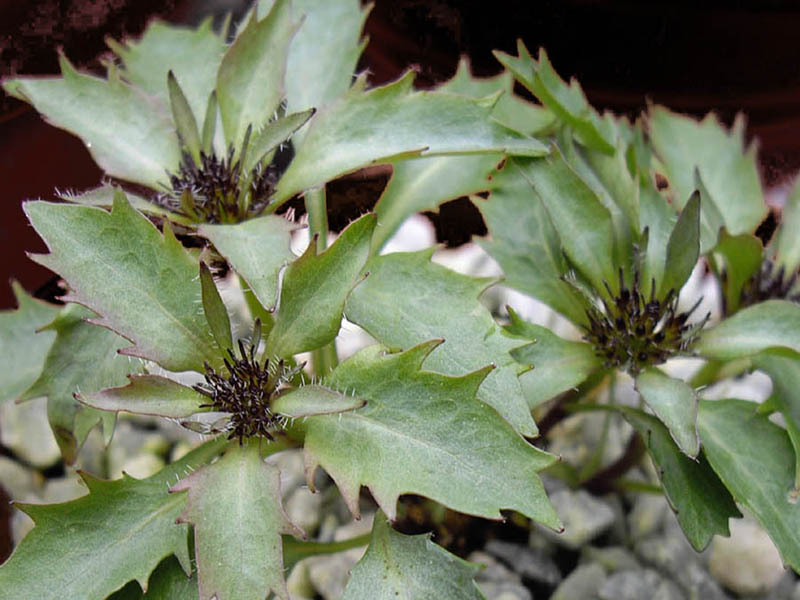
Perennial from the Campanulaceae family, Physoplexis comosa is an endemic species of the limestone Alps, mainly found in the Eastern Alps, from the Dolomites to the Austrian and Slovenian Alps. It exclusively colonizes the crevices of vertical or overhanging limestone cliffs, between 1,000 and 2,400 meters in altitude, often in the shade or north-facing exposure, where humidity is stable and drainage is perfect.
It forms small low tufts of 5 to 10 cm, with short stems bearing oval to diamond-shaped leaves, medium green, distinctly toothed to lobed, slightly leathery. In bud, the flower heads are striking: a tight mass of dark tubes, almost black to deep purple, which gradually elongate before anthesis.
At full bloom, each flower presents a narrow tubular corolla, lilac white at the base and ending in a dark purple-violet point, topped with a filiform style coiled like a shepherd's crook. The globular inflorescence in a dense umbel is one of the most unique in the alpine world. In its natural habitat, its flowering extends from July to August. In cultivation, it generally blooms in June-July.
It requires a limestone substrate, very well-drained, in a cool and semi-shaded exposure, sheltered from direct rain. Cultivation in a pot or vertical trough, with a mix of limestone gravel and tufa, is perfectly suitable. It is a demanding collector's plant, considered one of the jewels of alpine rock gardens.