Sub-shrub of the Ericaceae family, Phyllodoce caerulea is a circumpolar and arctic-alpine species, found in the boreal and mountainous regions of Northern Europe, Iceland, the northern British Isles, Scandinavia, as well as in Scotland where it is one of the most precious botanical rarities. In Central Europe, it reaches the Alps and the Carpathians, generally between 1,800 and 2,800 meters in altitude. It grows in moist alpine heaths, late snow beds, and acidic grasslands on siliceous substrates.
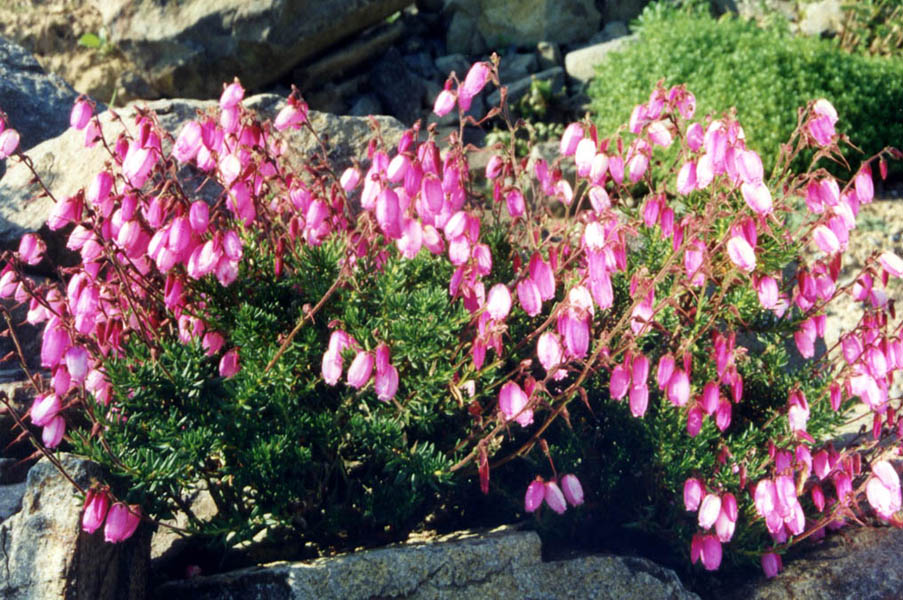
It forms low and dense bushy clumps, reaching 15 to 25 cm in height, with woody stems densely covered with linear, narrow, and channeled leaves, dark green and shiny, reminiscent at first glance of a small miniature conifer.
The flowers are pendulous, in bright pink to lilac pink ovoid bells, borne in loose terminal umbels on reddish glandular peduncles. Despite its epithet caerulea, the blue color is not observed in practice. In its natural habitat, it blooms from June to August depending on altitude. In cultivation, it generally blooms in May-June.
It requires an acidic, fresh to moist, well-drained soil, rich in humus, in a semi-shaded or sunny exposure in a cool climate. It does not tolerate limestone or summer drought. An excellent collector's plant, it is prized by enthusiasts of acidic rock gardens and alpine heathers.