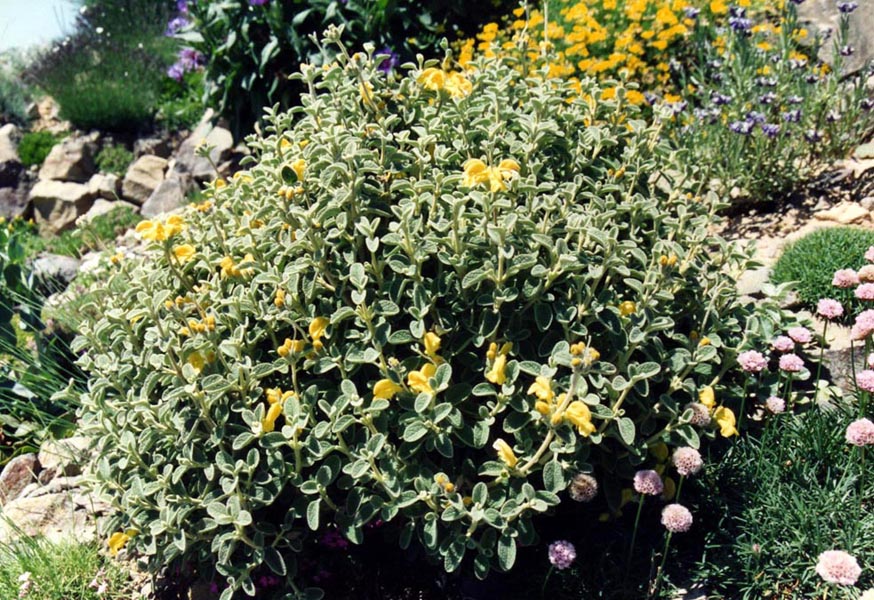
Phlomis lanata is a shrub of the Lamiaceae family, endemic to Crete, where it grows on dry rocky slopes, open scrublands, and limestone or schist slopes in full exposure, generally between sea level and about 1,000 meters.
It is distinguished from its close relatives by its strictly rounded and compact habit, forming a dense and regular dome reaching 50 to 80 cm in height with a span often greater. It is precisely this naturally ordered spherical silhouette without pruning that differentiates it at first glance from Phlomis fruticosa, which is looser and more erect. The small oval, thick leaves are covered with a dense silvery-gray tomentum on both sides, giving the whole a velvety and luminous appearance even when not in bloom.
The bilabiate flowers, of a bright and clear yellow, are borne in whorls at the nodes of the branches and literally cover the bush at the time of full bloom, to the point that the foliage almost disappears under their mass. In its natural habitat, its flowering extends from April to June; in cultivation under mild climates, it can begin in March.
It requires very well-drained, poor soil, in full sun, and easily withstands the most severe summer drought. Hardy down to -8 to -10°C without difficulty, and possibly beyond depending on cultivation conditions and winter drainage, it suffers more from persistent moisture in the cold season than from the cold itself, and performs very well under mild Atlantic climates as well as under Mediterranean climates.