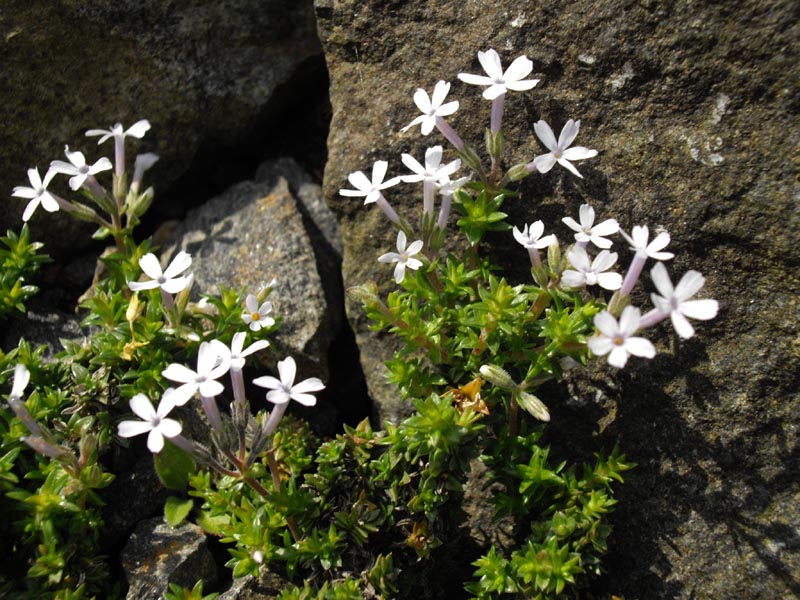
Perennial from the Polemoniaceae family, this miniature cultivar results from crosses between dwarf species of the genus Phlox, probably involving Phlox douglasii or closely related small-sized species. Its precise horticultural origin is not clearly documented in the sources consulted.
It forms an extremely compact and tight cushion, barely 3 to 5 cm in height, with evergreen foliage composed of very small oval-oblong leaves, from medium to bright green, giving the cushion a fine and mossy characteristic texture, distinctly different from the needle-like foliage of Phlox subulata. The flowers are small, white to white slightly washed with very pale lilac, with five narrow and well-separated petals, borne on thin upright stems that emerge above the cushion, giving it a light and delicate appearance.
In its natural habitat, the parent species bloom from May to July depending on altitude. In cultivation, flowering generally occurs in May-June.
It is particularly suitable for sinks, alpine troughs, and fine rockeries where the reduced scale is highlighted. It requires full sun, perfect drainage, and protection from stagnant winter moisture.