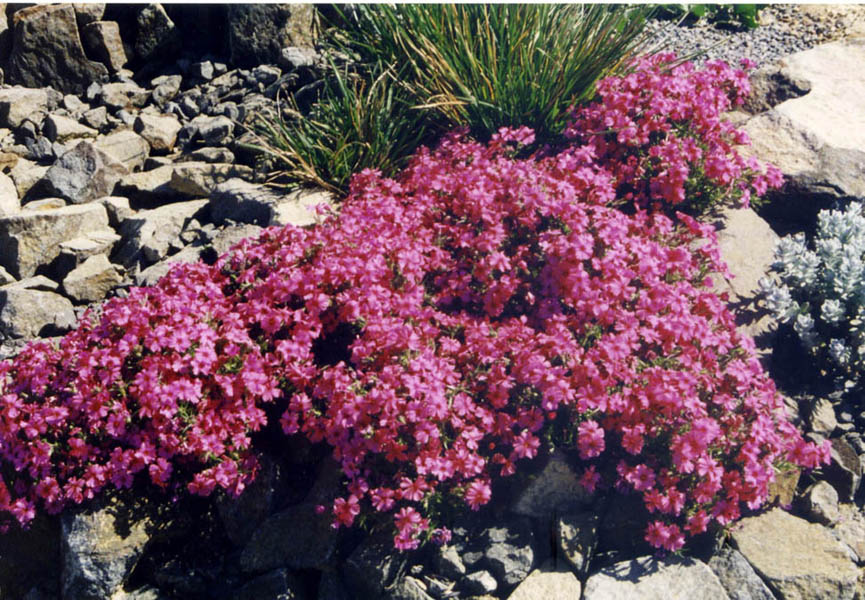
Perennial of the Polemoniaceae family, this cultivar is likely related to the Phlox subulata group, native to the eastern United States, where the species occupies rocky slopes, sandy outcrops, and well-drained dry prairies. The name 'Tetra Red' suggests an origin by polyploidization, a process used to obtain larger flowers, but this information could not be verified in the reference sources consulted and the exact attribution of the cultivar remains to be confirmed.
The plant forms large, dense, and rounded cushions, spreading over rocks and walls, reaching about 10 to 15 cm in height when in bloom. The foliage consists of narrow, linear to subulate leaves, medium to dark green, evergreen, typical of the group.
The flowers are a deep magenta pink to carmine pink, with a distinctly contrasting darker central eye and slightly notched wide petals at the top. The flowering, in May-June in cultivation, is remarkably dense and entirely covers the foliage at its peak, producing a very vigorous colorful mass effect in the rockery.
It requires well-drained, even poor soil, in full sun exposure, and does not tolerate stagnant moisture in winter. A light pruning after flowering helps maintain the compactness of the cushion.