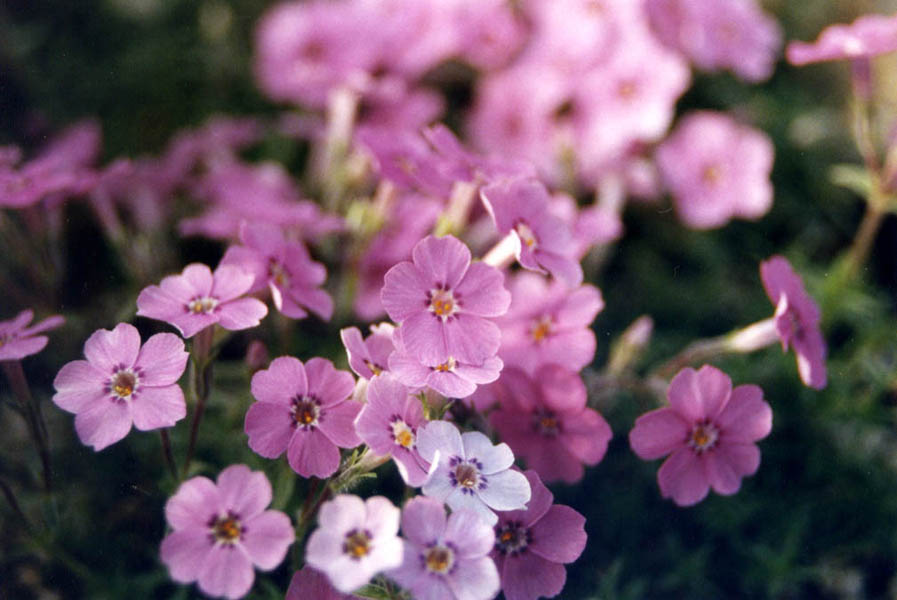
Perennial of the Polemoniaceae family, Phlox subulata is native to the eastern United States, where it colonizes rocky outcrops, dry slopes, and open edges on well-drained and poor substrates. The name brittonii, sometimes found in horticultural catalogs, is no longer retained as a distinct taxon by World Flora Online, which places it in synonymy with the type species.
It forms a dense, creeping mat, rarely more than 8 to 12 cm in height, with evergreen foliage composed of small, linear, subulate leaves of a dark green. During flowering, the foliage almost entirely disappears under a mass of five-petaled flowers slightly notched, of a bright and luminous lilac-pink, with a central orange-red eye circled with dark brown.
In its natural habitat, its flowering extends from April to June. In cultivation, it blooms from March-April depending on the climate.
It requires a fully sunny exposure, a very well-drained soil, dry to fresh, and poorly tolerates heavy and wet soils in winter. A light pruning after flowering keeps the cushion compact. Excellent plant for walls, rock gardens, and dry borders.