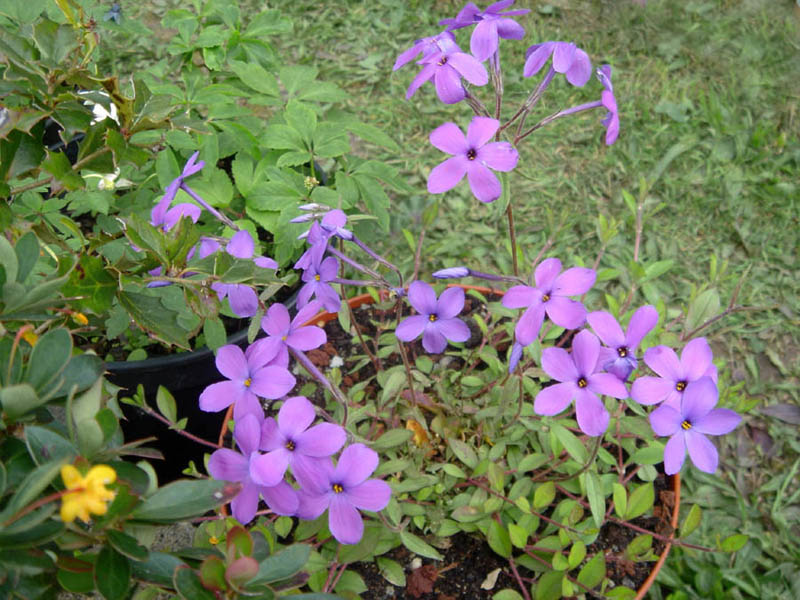
Perennial of the Polemoniaceae family, Phlox stolonifera is native to the eastern United States, mainly the Appalachians, where it colonizes cool and humid undergrowth, shaded banks, and wooded slopes, generally at low and medium altitudes. Its name directly refers to its mode of progression by stolons, which allows it to gradually form large carpets on the ground.
The plant spreads in low mats of 15 to 25 cm in height when in bloom, with the stoloniferous stems rooting upon contact with the soil. The leaves are oval to spatulate, a shiny medium green, arranged in persistent basal rosettes and along the flowering stems. The buds, remarkably colored, are an intense striated blue-violet, almost sculpted before anthesis.
The open flowers, gathered in loose cymes at the top of erect stems, are a bright lilac-purple with a dark center, widely open and slightly fragrant. In its natural habitat, its flowering extends from April to June. In cultivation under our climates, it generally occurs between April and May.
It thrives in light shade or partial shade, in fresh, humus-rich, and well-drained soil, without excess lime. Unlike the majority of rock garden phlox, it tolerates a certain amount of shade well and is suitable for woodland gardens or compositions at the edge of shaded beds.