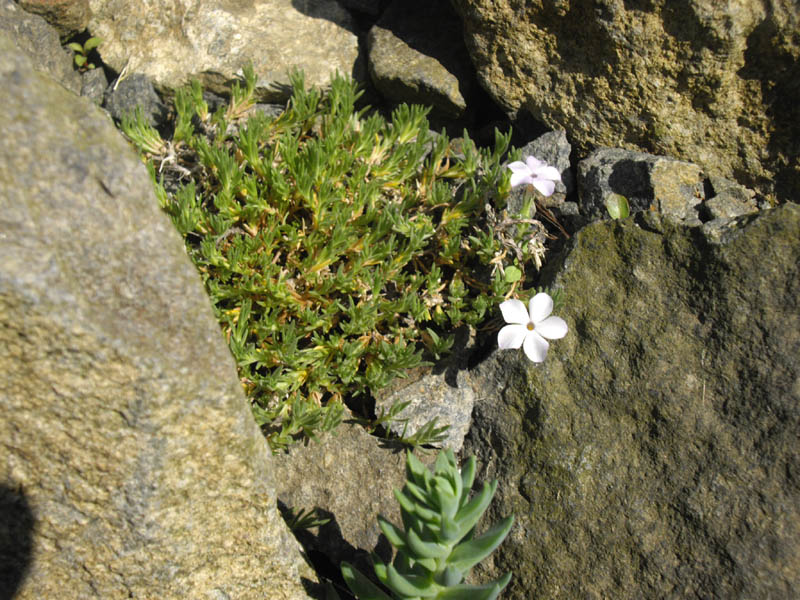
Perennial of the Polemoniaceae family, Phlox pulvinata is native to the Rockies and the Great Plains of the central-western United States, where it grows in scree, rocky lawns, and windy high-altitude ridges, generally between 2,800 and 4,000 meters. It is one of the most distinctly alpine phlox of the North American flora.
It forms dense and tight cushions, very close to the ground, barely exceeding 3 to 5 cm in height. The leaves are linear-needle-like, rigid, ciliate-glandular, of a grayish-green, arranged in imbricated rosettes that give the cushion a spiky and compact appearance, clearly visible among the stones.
The flowers, solitary, are borne flush with the cushion on very short stems. They are pure white to pale lilac, sometimes lavender, with a small discreet yellow-orange center. In its natural habitat, its flowering extends from June to August depending on altitude and snow cover.
In cultivation, it requires perfect drainage, a lean and mineral soil, and full sun exposure. It withstands intense cold under snow cover but dreads stagnant winter moisture. Cultivation in rock crevices or in a rock garden pot suits it particularly well.