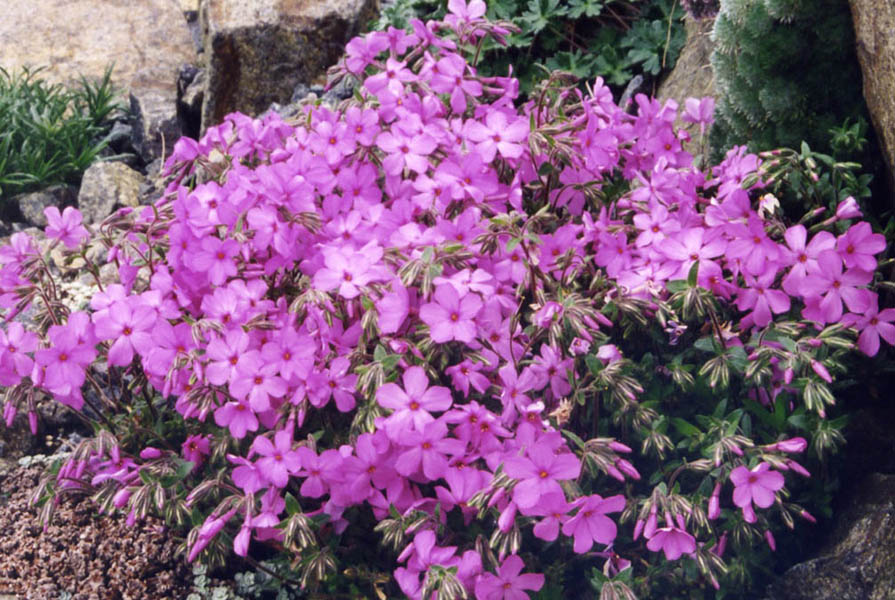
Perennial of the Polemoniaceae family, Phlox × procumbens is a natural hybrid resulting from the cross between Phlox subulata and Phlox stolonifera, native to the southeastern United States. It differs from the subulata group phlox by its wider, oval-lanceolate leaves, ranging from medium to dark green, borne on longer and more flexible stems.
The plant forms a spreading and rather loose carpet, reaching about 10 to 15 cm in height when in bloom, gradually extending over rocks and walls without forming the typical dense and mounded cushion of P. subulata. Its intermediate habit between its two parents is one of its most easily noticeable characteristics.
The flowers of the 'Rosea' cultivar are lilac-pink to mauve-pink, with a small, well-marked dark pink central eye and broad, entire-edged petals. The numerous flower buds borne on upright stems give the plant an airy silhouette at the time of flowering, which occurs in April-May in cultivation. The flowering is abundant without completely obscuring the foliage.
It requires well-drained soil in full sun exposure or slight partial shade, and tolerates relatively dry conditions once established.