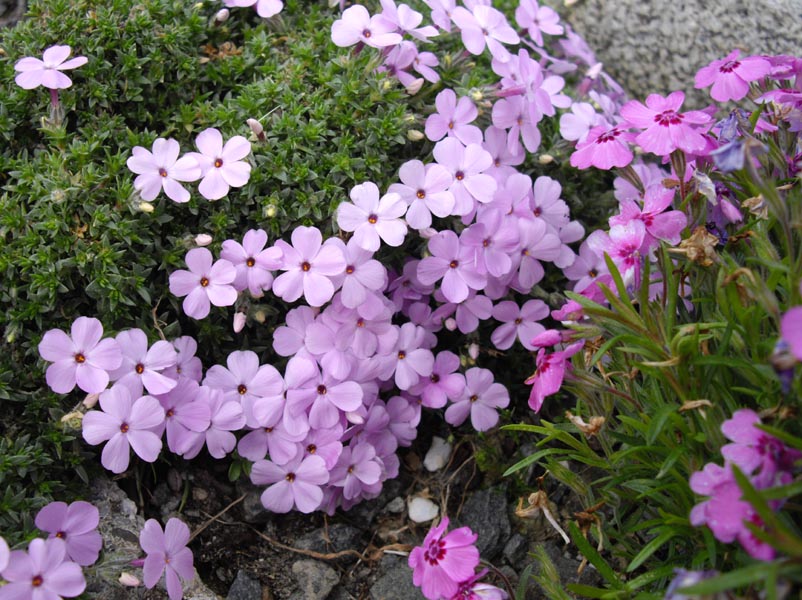
This cultivar is named after a commune in Maine-et-Loire, which unambiguously designates a French selection or commercialization. It is attributed to the former Lepage nursery, an Angevin establishment that played a notable role in the distribution of perennial plants in France during the twentieth century. The name is not recorded in international directories of known cultivars, and the exact botanical identity of this plant remains uncertain; its habit, foliage, and behavior very likely associate it with Phlox douglasii, family Polemoniaceae, but this attribution cannot be confirmed with certainty.
It forms a dense and moderately domed cushion, reaching 5 to 10 cm in height, with foliage composed of small linear leaves of a bright green, characteristic of the douglasii group. The flowering is generous and covers the cushion well.
The flowers are distinguished by a particularly soft hue, a very pale lilac pink tending towards light lavender, with a small reddish-brown central eye. The petals are wide, slightly overlapping, giving the flowers a full and rounded appearance. This delicate color, one of the lightest found in this group, is the most immediately recognizable feature of the cultivar. In cultivation, flowering generally occurs in May-June.
As with all dwarf phloxes of this type, it requires a very well-drained soil, poor to moderately fertile, in full sun exposure, and does not tolerate stagnant moisture in winter.