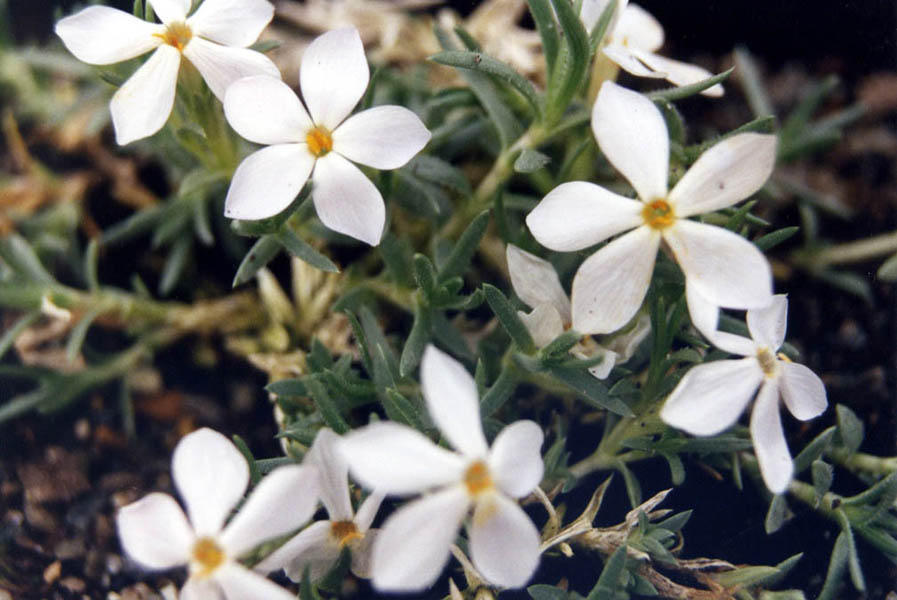
Perennial of the Polemoniaceae family, Phlox kelseyi is a North American species whose natural range mainly covers Montana, Idaho, and Wyoming. It grows in high-altitude dry meadows, rocky slopes, and well-drained clay to gypsum soils, often in open and sunny environments.
It forms a creeping and spreading mat, slightly raised, reaching 5 to 8 cm in height. The foliage is distinctly different from that of other dwarf phloxes by its broader, oval-lanceolate to spatulate leaves, a shiny dark green, visibly ciliated on the margins, giving it a softer texture and less prickly than that of P. douglasii or P. subulata.
The flowers, relatively large for the size of the plant, have five broad and rounded petals, a pure white slightly veined, centered with a well-marked golden-yellow eye. They are borne individually above the foliage and are distributed quite loosely over the mat, without completely covering it. In its natural habitat, its flowering extends from May to July depending on altitude and exposure. In cultivation, it generally occurs in May-June.
It requires a very well-drained, mineral soil, poor to moderately fertile, in full sun exposure. It tolerates calcareous and even slightly gypsum substrates. As with all dwarf phloxes, stagnant winter moisture is its main constraint in cultivation.