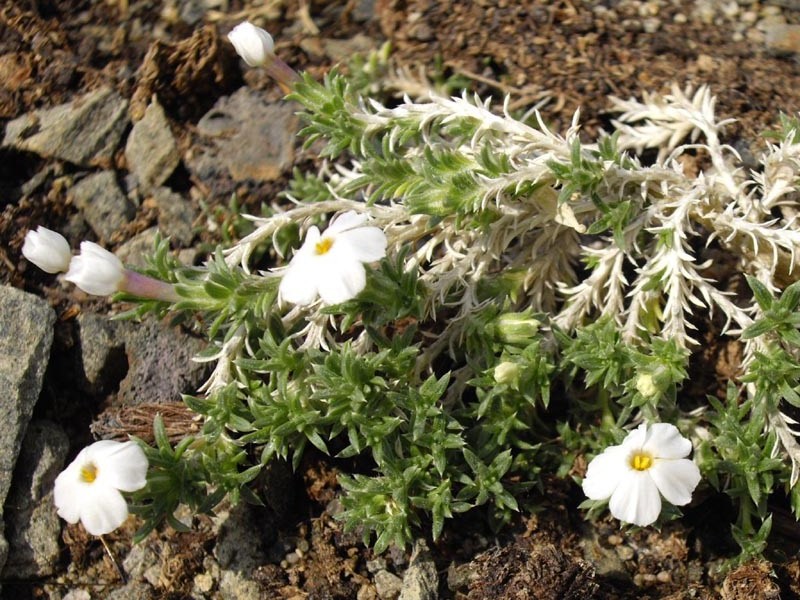
(Phlox tumulosa)
(Phlox tumulosa)
A perennial of the Polemoniaceae family, Phlox griseola is a species from the western part of North America, with the subspecies tumulosa limited to a restricted area of Utah and Colorado. It grows in very open environments, on dry rocky or gravelly substrates, often on sedimentary formations with an arid character, at medium to high altitudes. It is a species rarely found in cultivation, mostly seen in specialized collections of alpine plants.
It forms a sprawling to creeping mat, slightly domed, reaching 4 to 8 cm in height. Its most immediately striking feature is the dense, woolly pubescence that entirely covers the stems and foliage, giving them a very pronounced silver-white to cream-white hue. The leaves are small, linear-lanceolate, tightly packed on the stems, with ciliate margins. This woolly covering, an adaptation to arid conditions and intense sunlight of its natural habitat, clearly distinguishes this subspecies from most other dwarf phlox.
The flowers, pure white to slightly pink in bud, have five broad, rounded petals centered with a distinct yellow eye. They are borne in small numbers above the foliage, allowing them to stand out clearly against the silvery background of the plant. In its natural habitat, its flowering probably extends from May to July depending on altitude and exposure; in cultivation, it generally occurs in May-June. Precise data on the phenology of this subspecies remain poorly documented.
It requires a very well-drained, mineral, and poor soil, in full sun exposure. It is adapted to summer drought and does not tolerate prolonged moisture, especially in winter. Its cultivation is more demanding than that of common P. douglasii cultivars and is better suited to draining rock gardens, alpine gravel, or container culture.