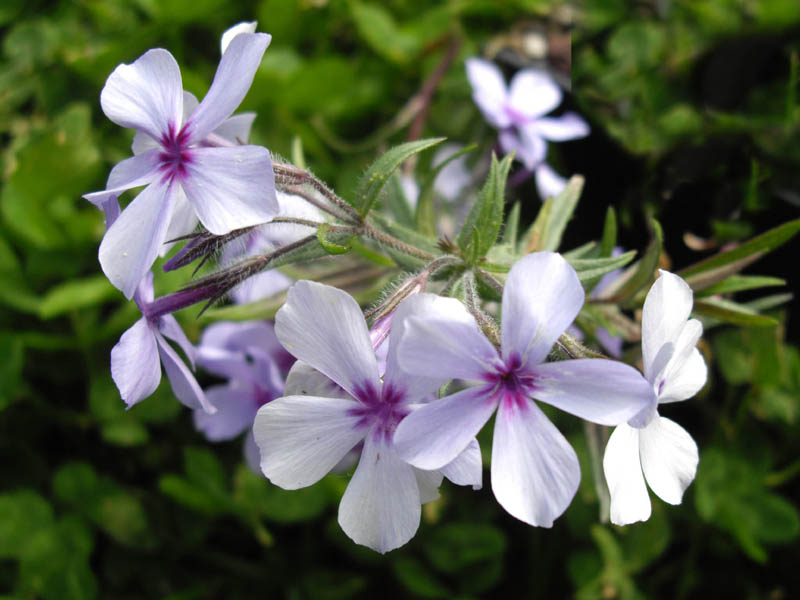
Selected cultivar from the subspecies laphamii, native to central and southeastern North America. Its name evokes the Chattahoochee River in Florida, where the plant is said to have been discovered by British gardener Edward Dunnett in the 1950s.
The plant forms loose clumps of semi-upright stems, reaching 15 to 20 cm in height, slightly more compact than the type species.
The flowers are a very pale lilac, almost white washed with mauve, with a very pronounced purple-violet central eye which is the most immediately distinctive feature of this cultivar. The petals are broad, slightly notched, and the flowering stems are distinctly pubescent, as clearly shown by the hairy calyces visible at the insertion of the flowers.
In its natural habitat, the subspecies blooms from April to June. In cultivation, 'Chattahoochee' generally blooms in April-May, with sometimes a slight resurgence in autumn.
It prefers a cool, humus-rich, well-drained soil, in partial shade or light shade. It does not tolerate prolonged drought or waterlogging. A light mulch in summer helps to maintain soil freshness.