Perennial of the Polemoniaceae family, native to California and Nevada, where it occupies dry, open rocky slopes, with a notable preference for limestone and travertine substrates. It is a high mountain plant of the Sierra Nevada, reported at over 3,000 meters.
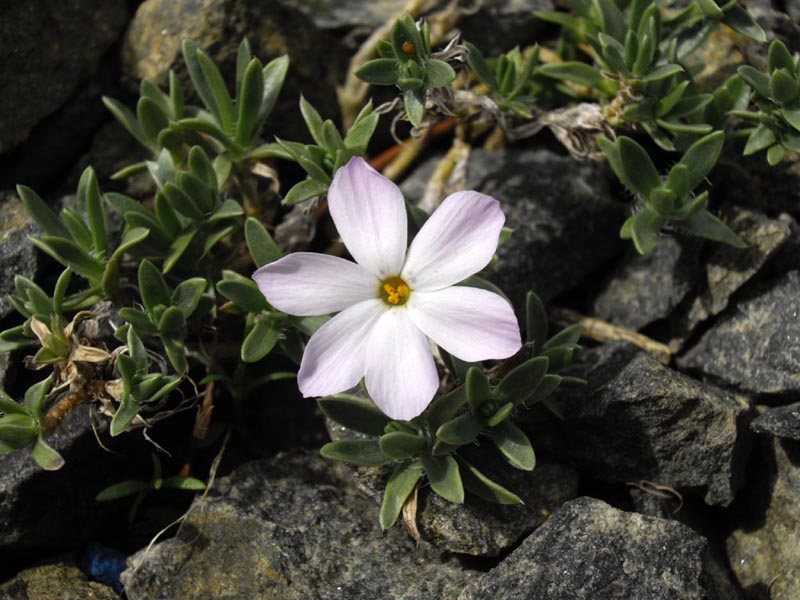
It forms tiny, very compact cushions, barely 5 cm high, woody at the base. The foliage consists of oval to spatulate leaves, medium green, quite broad for the genus, arranged in sparse rosettes along the branched stems, giving it a less prickly appearance than strictly needle-like species.
The flowers are large relative to the size of the plant, solitary, with five well-developed petals, white to pale pink, with slightly more pronounced veins, and a bright yellow-orange center. This ample flower borne by a tiny cushion resting directly on the rocks is one of the most striking features of the species.
In its natural habitat, its flowering extends from June to August.
Delicate species in cultivation, it requires absolute drainage, a very mineral substrate preferably limestone, and full sun exposure. Its rarity in horticulture reflects the difficulty in reproducing the dry and mineral conditions of its native mountain. It is suitable for specialized cultivation in an alpine trough or cold greenhouse.