Perennial of the Polemoniaceae family, native to the western North America, from the Great Plains to the foothills of the Rockies, from Montana and Idaho to Wyoming and Colorado. It grows on rocky and gravelly slopes, high-altitude dry meadows, and well-drained substrates, often on poor sandy or loamy soils, between approximately 1,500 and 2,800 meters.
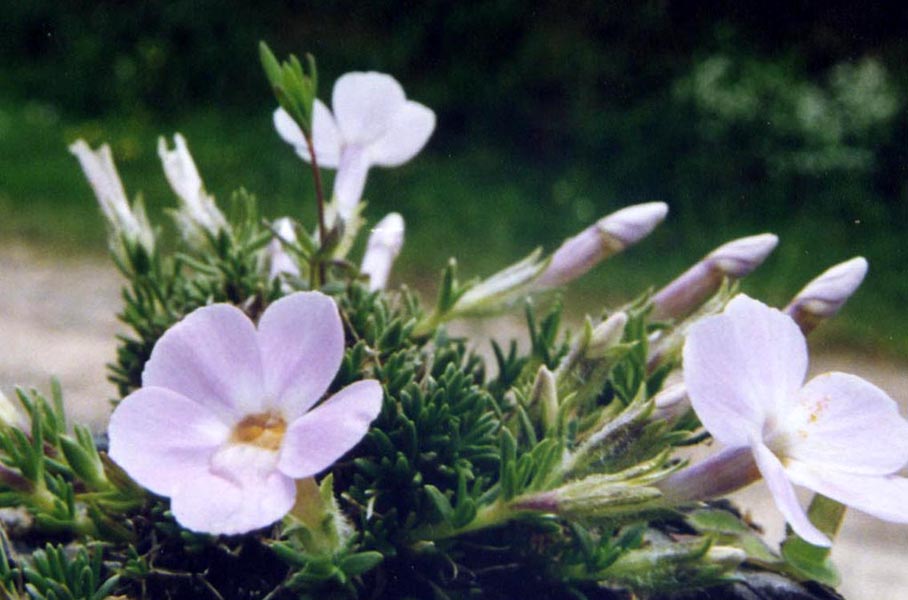
It forms small, dense, and tight cushions, woody at the base, with a height of 5 to 10 cm, growing slowly. The foliage consists of very short, stiff linear leaves, medium green, arranged in interlocking rows along the branched stems, giving the cushion a characteristic spiny and compact appearance when not in bloom.
The flowers are solitary, borne directly on the cushion, with five broad and well-rounded petals, a white very slightly tinged with pale lilac pink, with a visible yellow-orange center. The flower buds, lavender to pink, contrast nicely with the almost white open flowers.
In its natural habitat, its flowering extends from May to July depending on the altitude. In cultivation, it generally occurs in April-May.
It requires rigorous drainage and a very mineral, poor, and dry substrate. It does not tolerate stagnant moisture, particularly in winter. Cultivation in dry rock gardens, rock crevices, or alpine troughs suits it perfectly. Its slow growth makes it a plant of patience, but its dense cover and delicate flowering reward the wait.