Perennial of the Polemoniaceae family, whose taxonomic status remains debated according to authors, some treating it as a distinct entity, others associating it with Phlox borealis or Phlox sibirica. It is native to the arctic and subarctic regions of Alaska and northern Canada, where it occupies environments comparable to those of the type species, on well-exposed gravel and tundras.
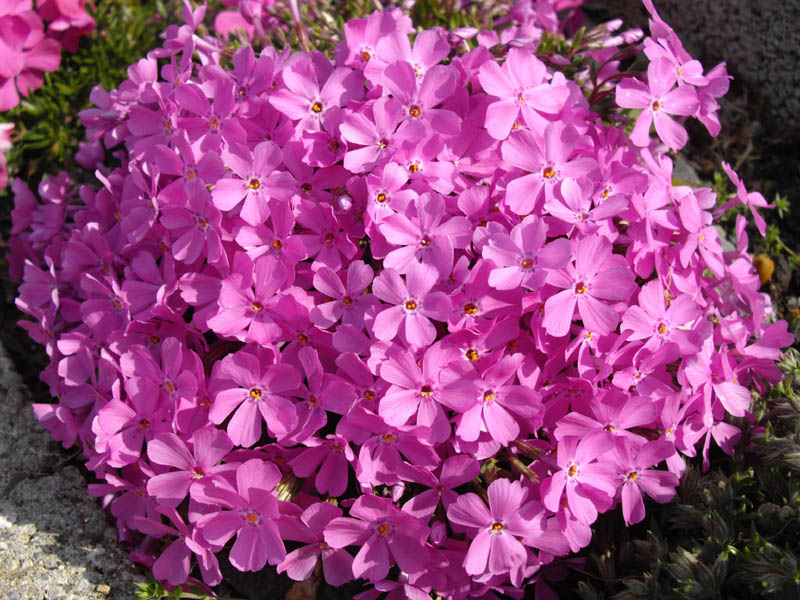
Compared to Phlox borealis, this subspecies has a more distinctly dense and rounded cushion-like habit, more compact, reaching 5 to 8 cm in height. The foliage, composed of short, rigid linear leaves, is denser and remains largely hidden beneath the flowering.
The flowers are a deep, warm magenta pink, more intense than the type form, with well-rounded petals and a marked brown-orange central eye. Produced in great density, they cover the cushion to the point of leaving virtually no foliage visible at the peak of anthesis, giving a solid mass of color.
In its natural habitat, its flowering extends from June to July. In cultivation, it generally blooms in April-May.
The cultural requirements are identical to those of the type species: impeccable drainage, poor and mineral substrate, full sun, and protection against prolonged winter humidity.