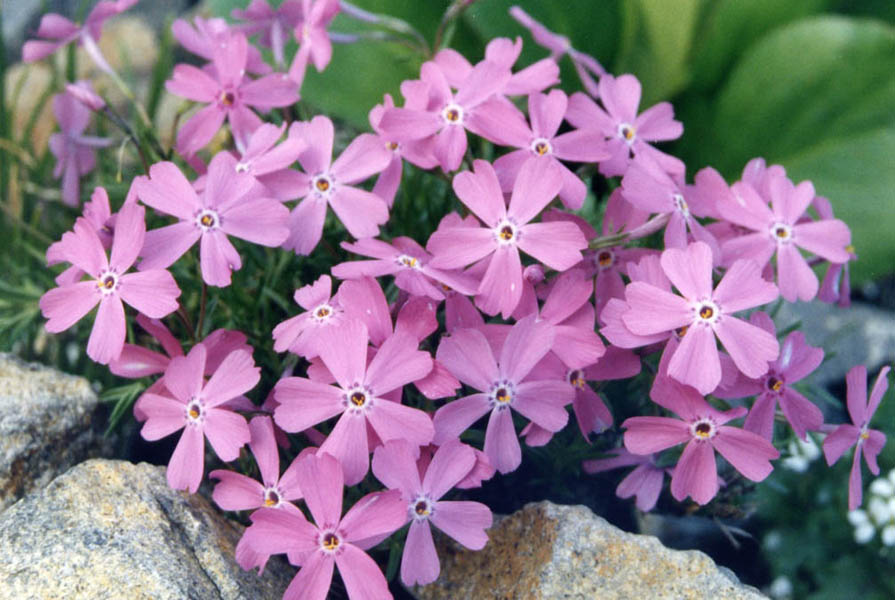
(Phlox borealis)
(Phlox borealis)
Perennial of the Polemoniaceae family, native to circumpolar and subarctic regions, from Alaska and northwestern Canada to the arctic areas of Siberia. It occupies open tundras, gravelly slopes, and well-drained mineral substrates, exposed to full sun in conditions of intense cold and low vegetation.
It forms loose to semi-dense mats, with a modest height of 5 to 10 cm, with a creeping and spreading habit rather than strictly cushion-like. The foliage consists of narrow linear leaves, medium green, arranged in spaced tufts along the stems.
The flowers are a fairly bright lilac pink to purplish pink, with five rounded and slightly notched petals, with a small, well-visible central orange eye. They are borne in sufficient numbers to form a colorful carpet, but the foliage remains partially visible between the flowers, which visually distinguishes this taxon from more compact forms with flowering that entirely masks the foliage.
In its natural habitat, its flowering extends from June to July depending on the latitude. In cultivation, it generally occurs in April-May.
It requires perfect drainage, a low-fertility mineral substrate, and a sunny exposure. Very hardy, it poorly tolerates stagnant winter moisture. Suitable for draining rock gardens and containers.