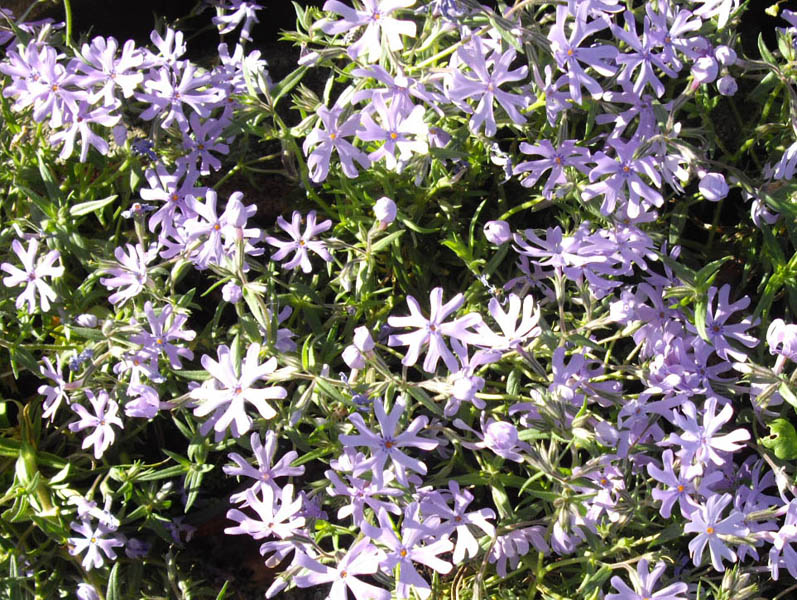
Perennial of the Polemoniaceae family, native to the central-eastern United States, mainly from Illinois, Indiana, and neighboring states, where it grows on rocky outcrops, sandstone cliffs, and well-drained sandy slopes, in full sunlight.
It forms semi-prostrate, slightly bushy clumps, 10 to 20 cm in height, spreading quite widely over time. The foliage is evergreen, composed of small linear and rigid leaves, medium green, densely arranged along woody stems at the base.
What immediately distinguishes this species from all others is the shape of its petals, deeply bifid — that is, divided into two narrow lobes — giving each flower a very characteristic ten-branched star-like appearance. The flowers are light lilac to lavender, sometimes almost white depending on the individuals, with a small central orange to brown eye. They are produced in great abundance, literally covering the foliage at the peak of flowering.
In its natural habitat, its flowering extends from April to May. In cultivation, it generally occurs in April, sometimes as early as late March in well-exposed situations.
It requires a very well-drained soil, poor to moderately fertile, in full sun. Robust and undemanding once established, it adapts to rock gardens, walls, and dry embankments.