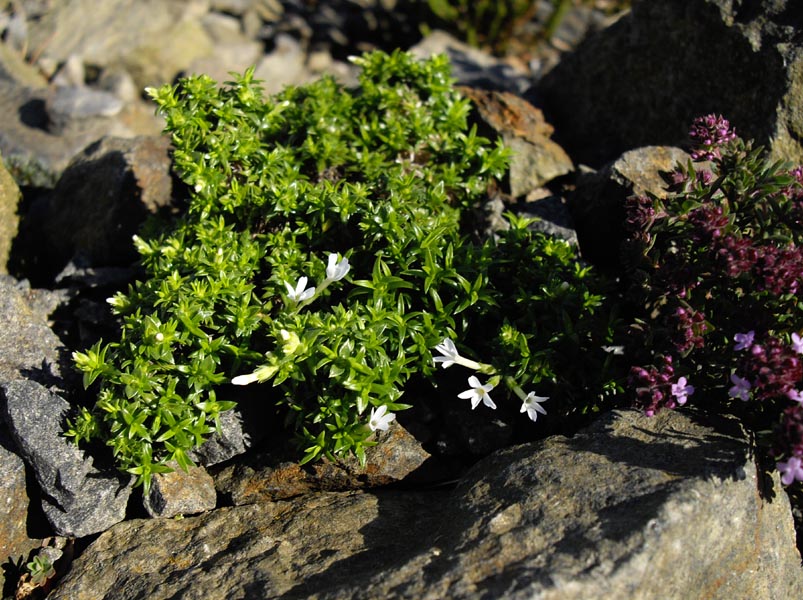
Perennial of the Polemoniaceae family, native to the mountains of the southwestern United States — Southern California, Nevada, Utah, Arizona — where it colonizes rocky slopes, screes, and rock crevices, generally between 1,500 and 3,000 meters altitude.
It forms dense and compact cushions, strictly prostrate, 5 to 10 cm in height, closely fitting the shape of the rocks between which it inserts itself. The leaves are very small, linear to subulate, bright green, rigid, tightly along the woody stems at the base, giving the plant a finely textured, almost mossy appearance from afar.
The flowers, borne individually at the end of the short flowering stems, are white to slightly creamy white, with five narrow and well-separated petals, giving them a distinctive starry appearance, different from the widely spread limb of other dwarf phlox. The floral tube is thin and elongated.
In its natural habitat, its flowering extends from May to July depending on the altitude.
In cultivation, it requires perfect drainage, a poor mineral substrate, in full exposure. It is suitable for rock gardens, walls, and trough cultures, but does not tolerate excess winter moisture well.