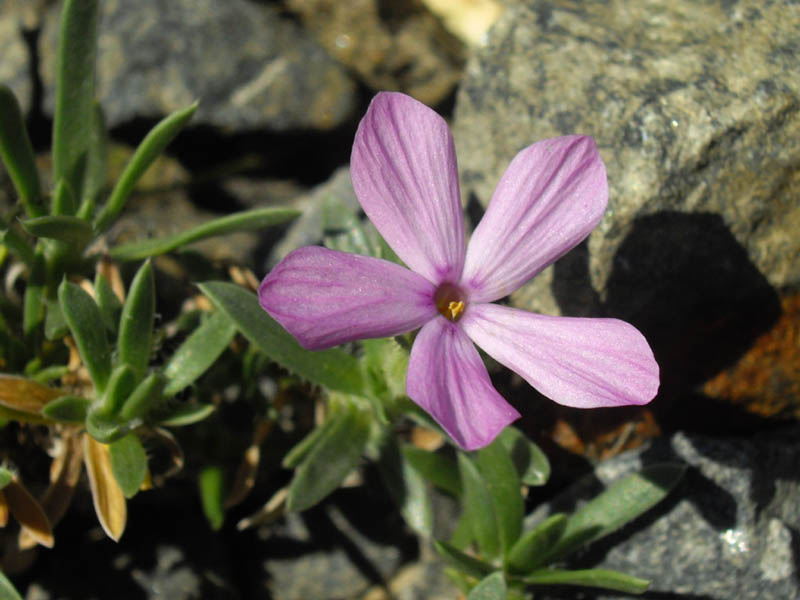
Perennial of the Polemoniaceae family, native to the Great Plains and the foothills of the Rockies, from Montana and Wyoming to the south of Alberta and Saskatchewan. It inhabits dry prairies, rocky slopes, and open screes, on well-drained substrates, often calcareous or sandy.
It forms small low and dense tufts, about ten centimeters high, with narrow and linear foliage reminiscent of an Alyssum — this is the origin of its epithet. The medium green leaves are rigid and arranged in tight rosettes along the woody stems at the base.
The solitary flowers or in small terminal groups are a fairly bright lilac-pink, with five widely spread petals, traversed by more pronounced veins converging towards a pale yellow center. This visible veining gives the flower a characteristic radiant appearance.
In its natural habitat, its flowering extends from May to June.
In cultivation, it requires a very well-drained soil, poor to moderately fertile, in full exposure. It is perfectly suited to sunny rock gardens and steppe gardens, and withstands significant cold provided that winter moisture is limited.