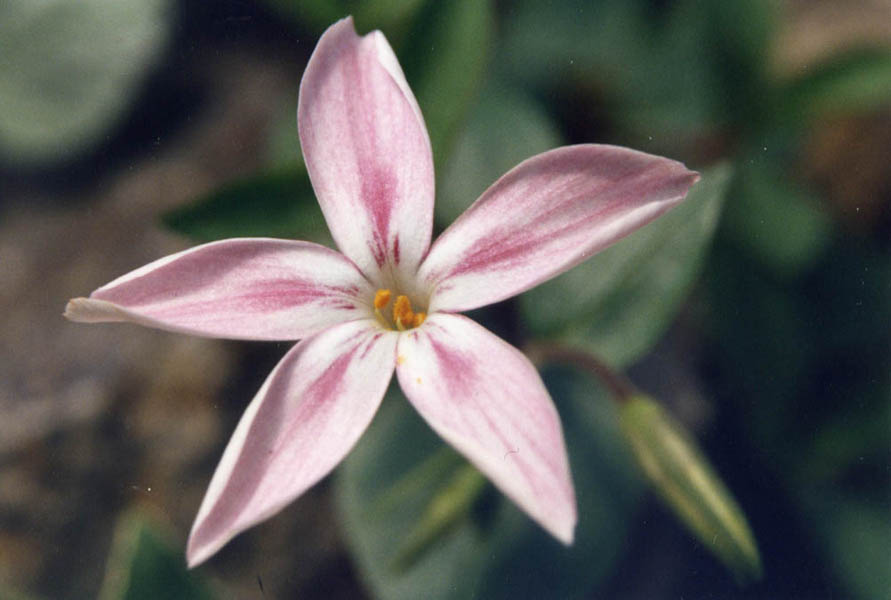
Perennial of the Polemoniaceae family, native to the northwest of the United States, where it is indigenous to the coastal forests and wooded slopes of Oregon and northern California, between approximately 300 and 1,500 meters.
It naturally grows in light undergrowth, on humus-rich, fresh, and well-drained forest soils, in light shade or semi-shade. Its habit is semi-prostrate to slightly ascending — precisely what its Latin epithet suggests — forming loose and supple mats about fifteen centimeters high.
The leaves are oval, a bright and shiny green, arranged in pairs along the stems, giving it a denser and more brilliant foliage than many of its congeners. The flowers, borne in small terminal clusters, have five widely spread petals, from soft pink to salmon pink, traversed by a more pronounced central vein, bright pink to rosy red, and marked with an orange center. This striated star pattern is particularly elegant and recognizable.
In its natural habitat, its flowering extends from May to July. In cultivation, it generally blooms in May-June.
It requires fresh, humus-rich, well-drained soil, in a shaded or semi-shaded position; it does not tolerate dry heat or full sun in summer. It is remarkably suited to woodland gardens and cool shaded rockeries.