Perennial of the Poaceae family, Phalaris arundinacea is a grass native to the temperate zones of the northern hemisphere, found in Europe, Asia, and North America. In nature, the species colonizes riverbanks, marshes, and moist meadows, from sea level to mid-altitude.
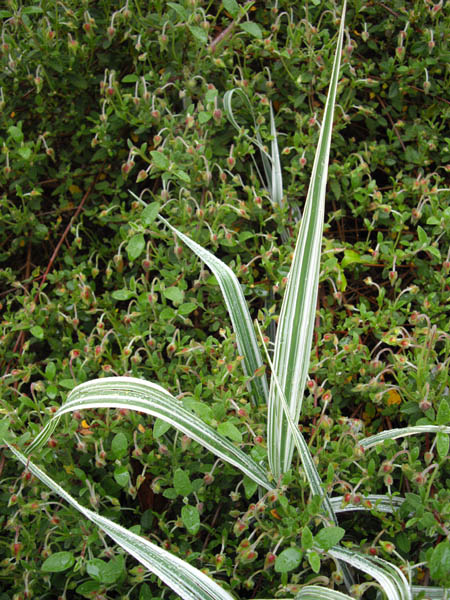
The cultivar 'Picta', known in gardens as "gardener's ribbon", forms upright clumps. Its appeal lies entirely in its foliage: long ribbon-like leaves, longitudinally striped with creamy white and green, which stand out effectively against a background of dense, dark vegetation.
The inflorescences, in compact whitish panicles, appear in June-July but remain secondary to the foliage. In its natural habitat, its flowering extends from June to August.
In dry and low-fertility soil, the plant remains well-behaved, forming a compact clump of 20 to 30 cm, without a tendency to spread. It is in rich and constantly moist soil that it can expand and spread by rhizomes. It tolerates both sun and partial shade.