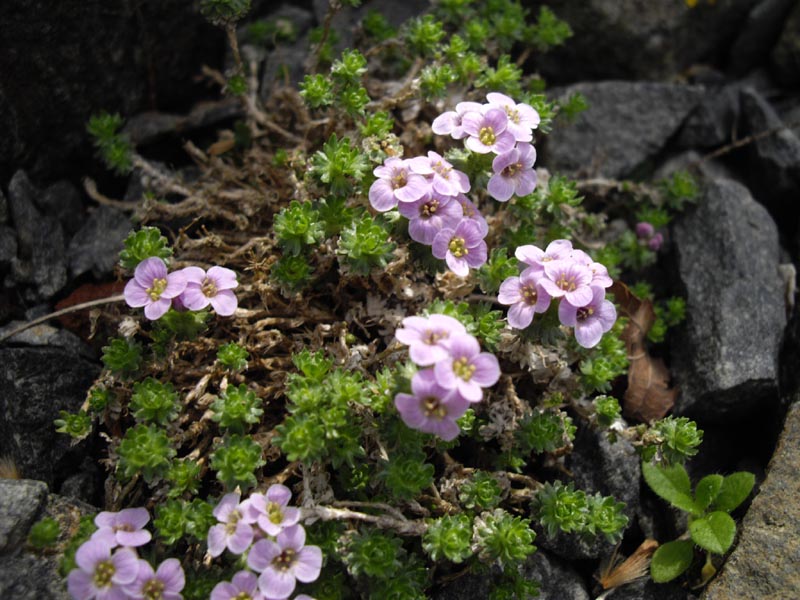
Perennial of the Brassicaceae family, found in the Pyrenees, the Alps, and the northern Apennines. It colonizes limestone screes, rock fissures, and exposed rocky ridges, generally between 1,800 and 3,000 meters in altitude, in locations often swept by wind and with prolonged snow cover.
It forms small, dense, and compact cushions, rarely more than 5 to 8 cm in height, with woody stems at the base, covered with tiny palmatilobed leaves with three or five lobes, bright green, slightly ciliated. This compact cushion architecture allows it to withstand the extreme conditions of the alpine zone.
The flowers, with four petals arranged in a cross, are a delicate pink lilac, with a well-visible pale yellow center. They are produced abundantly and almost completely cover the cushion at the time of flowering, emitting a light vanilla scent — a surprising characteristic for a high-altitude crucifer, and notable enough to be mentioned by the Alpine Garden Society.
In its natural habitat, its flowering extends from June to August depending on altitude and exposure. In cultivation, it requires perfect drainage, a lean calcareous substrate, and full sun exposure; it is ideally grown in a trough or moraine, and does not tolerate stagnant winter moisture well.