Petrocoptis hispanica is a perennial from the Caryophyllaceae family, endemic to the Iberian Peninsula, mainly the Spanish Pyrenees and Cantabrian massifs. It occupies cliff cracks and rocky walls, on varied substrates, in well-drained locations.
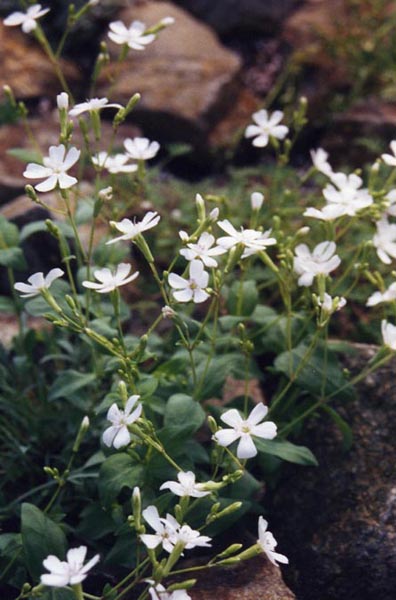
It forms fairly dense bushy clumps, reaching 10 to 15 cm in height when in bloom, with branched stems bearing medium green, oval, non-glaucous foliage, which immediately distinguishes it from P. glaucifolia. The photos show a generous plant, covered with flowers to the point of almost entirely masking the foliage at full bloom.
The flowers with five deeply notched petals are white to slightly pinkish white, with a small visible pale pink center, borne in loose cymes on slender stems. The flowering is very abundant and gives the clump a vaporous and luminous appearance.
In its natural habitat, its flowering extends from May to July. In cultivation, it requires perfect drainage, a rather poor and mineral soil, and tolerates sunny to semi-shaded exposure well. It dreads stagnant moisture in winter. Ideal in rock gardens or inserted into a stone wall.