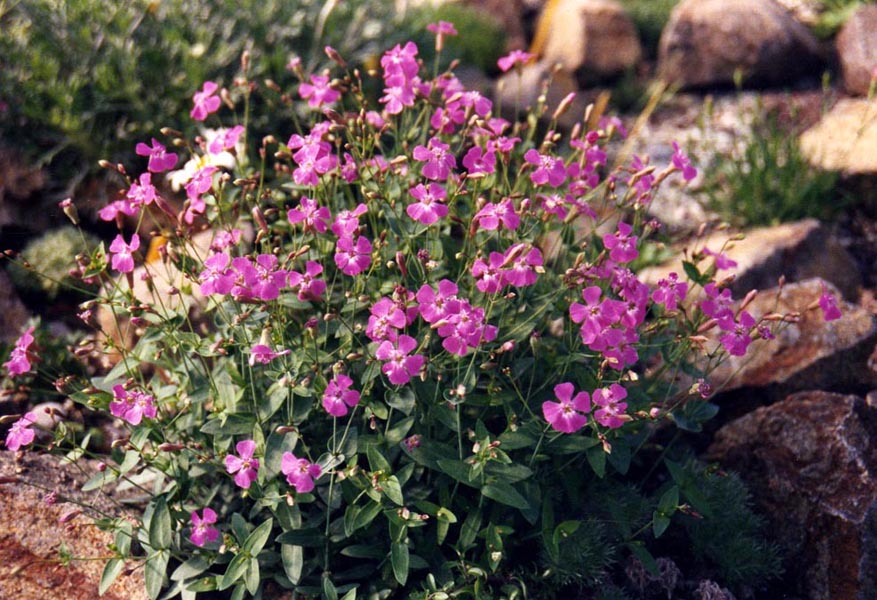
Petrocoptis glaucifolia is a perennial of the Caryophyllaceae family, endemic to northern Spain, mainly Cantabrian distribution. It grows in the crevices of limestone cliffs and shaded or semi-shaded rock faces, in well-drained but protected stations from excessive summer drought.
It forms loosely bushy clumps, reaching 10 to 15 cm in height in bloom, with slender and branched stems. The leaves, oval-spatulate, are a rather characteristic glaucous green, slightly fleshy, which precisely recalls its specific epithet. This bluish foliage provides a discreet background that highlights the flowering.
The flowers, borne in loose cymes at the top of filiform stems, have five deeply notched petals, a bright pink to deep magenta pink, with a small white eye in the center. Their production is abundant and extends over a long period.
In its natural habitat, its flowering extends from May to July. In cultivation, it often shows more generosity. It appreciates a well-drained limestone soil, in a semi-shaded exposure like its natural habitat on the wall, and poorly tolerates winter water stagnation. It finds its place in rock walls or crevice gardens.