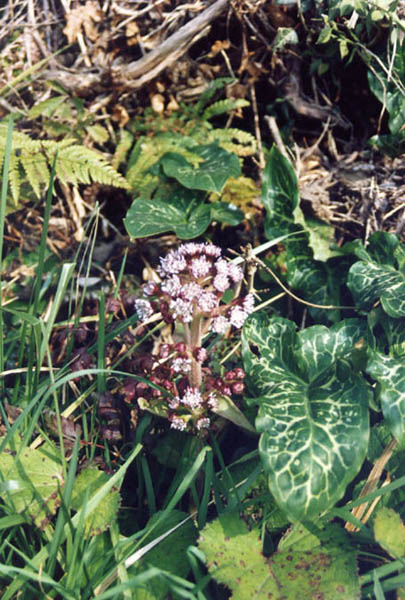
Perennial of the Asteraceae family, native to the western Mediterranean basin, mainly from North Africa, Italy, and Sicily. Naturalized in Great Britain, Ireland, and various regions of Western Europe, it willingly colonizes shaded banks, roadsides, hedges, and abandoned gardens, always in a cool and sheltered situation.
Like all Petasites, it blooms well before its foliage develops. The floral stems, short and fleshy, reach 15 to 20 cm at the time of flowering; they bear scale-like bracts tinged with purple and end in a dense corymb of small tubular capitula, pale pinkish-white to lilac, grouped in a compact and rounded mass. The still-closed buds, a deep reddish-purple, contrast nicely with the open flowers.
What immediately distinguishes this species among the Petasites is its fragrance, sweet and vanilla-like, perceptible at a short distance — a rare quality in the genus, and the origin of its epithet fragrans. The foliage, which develops after flowering, is broad, heart-shaped, medium green, with a long petiole.
In its natural habitat, its flowering extends from December to February, making it one of the earliest flowering plants of the year in Western Europe. In cultivation, it appreciates a cool, humus-rich soil, in partial shade, and can form invasive colonies through its rhizomes; to be contained in small spaces.