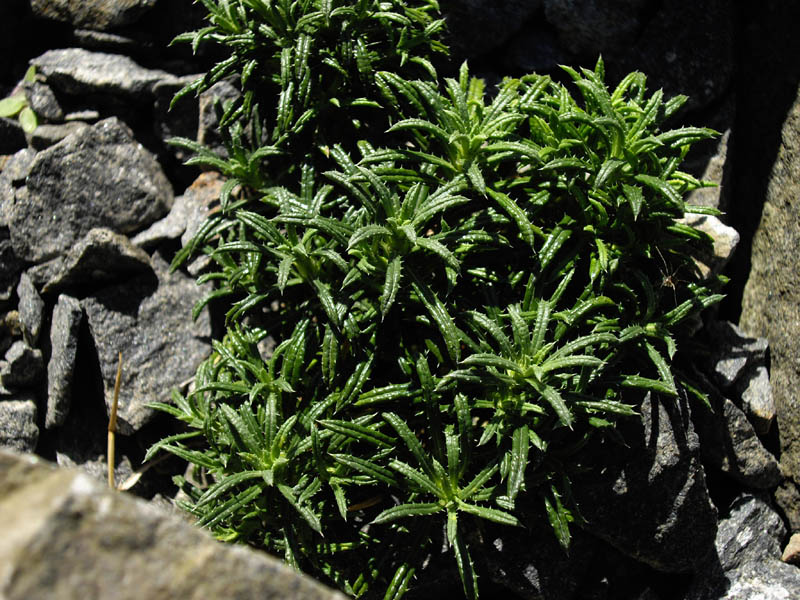
Perezia recurvata is a perennial of the Asteraceae family, native to Chile, where it is found in a wide range of habitats, from coastal interior valleys to areas near the tree line, between approximately 500 and 1,800 meters. It grows in sun-exposed environments, generally humid conditions with almost constant precipitation and short dry periods.
It adopts a compact and bushy habit, forming dense and low clumps of less than 10 cm, composed of many woody stems at the base, densely leafy. The leaves are small, narrow, linear to lanceolate, with spiny-toothed margins, dark green and leathery, arranged in tight rosettes that from a distance resemble certain Acantholimon or small miniature holly.
The flower heads, borne individually at the end of short stems, are composed of narrow ligules, pale blue to blue-lilac, opening widely in a star shape above the foliage. The flower buds are tinged with brown-purple before anthesis. In its natural habitat, its flowering extends from January to February depending on the locations.
In cultivation, it appreciates some humidity, contrary to what its spiny appearance might suggest, but requires well-drained soil and full sun exposure. In our climates, it is the stagnant winter humidity that is fatal to it much more than the frost itself; protection against winter rains, even light, allows it to withstand severe cold without damage.