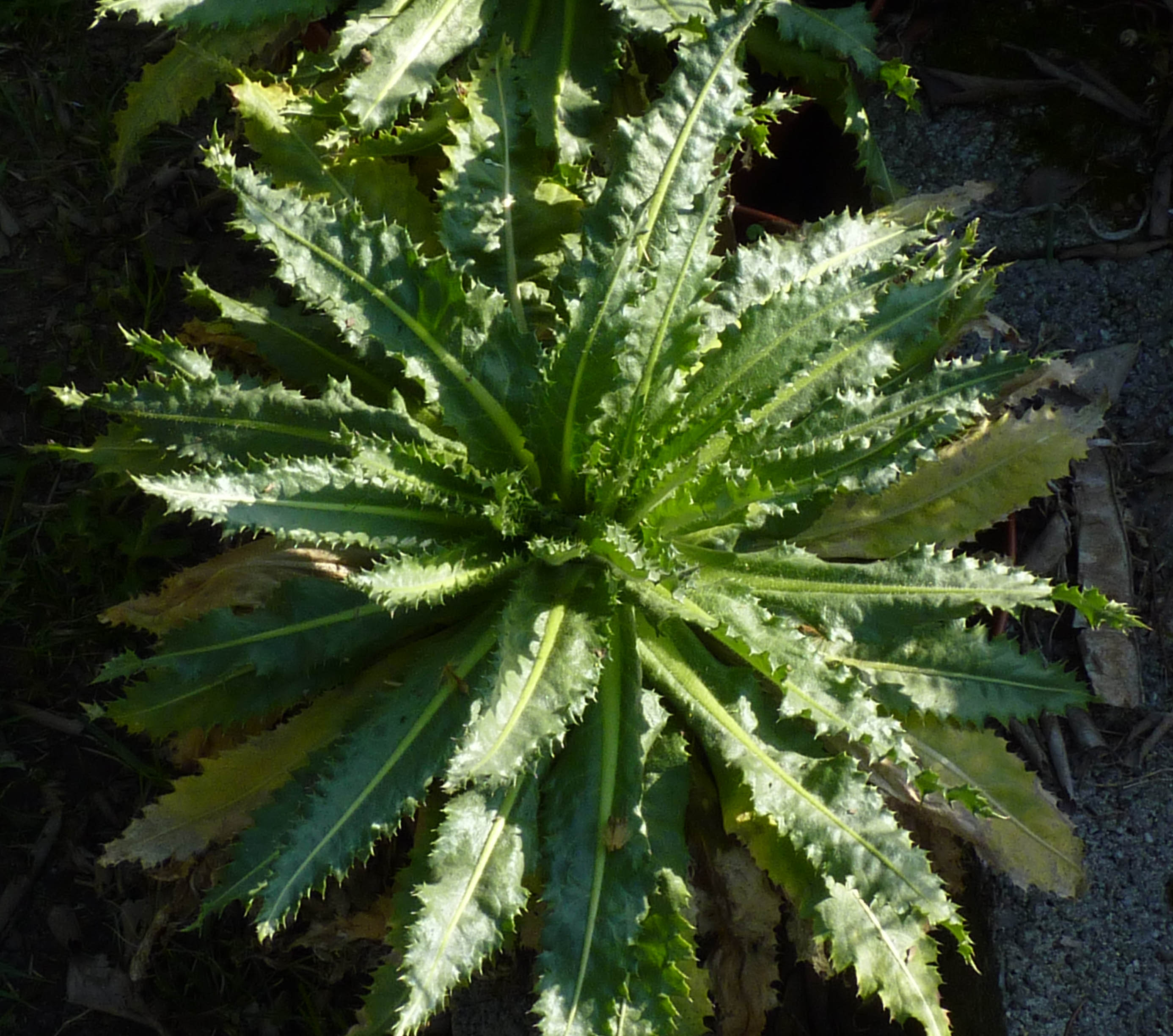
Perezia multiflora is a perennial of the Asteraceae family, native to the Andes of South America, where it grows in high-altitude grasslands and rocky areas, mainly in Peru, Bolivia, and Argentina, between approximately 3,000 and 4,500 meters.
The plant forms a well-characteristic basal rosette, spread flat, of lanceolate to oblong, dark green, leathery leaves with spiny-toothed margins vaguely reminiscent of a thistle or a small vegetative agave. This spiny rosette gives rise to erect stems 40 to 70 cm tall, bristling with stiff hairs, bearing sessile clasping cauline leaves.
The capitula, numerous and arranged in a loose corymb, are composed solely of ligulate flowers, all similar, of a true lilac-blue to blue-violet, with a very visible center of golden anthers surrounded by curved white stigmas. The floral bud, tight and spherical, of an intense violet, gradually opens by spreading its ligules with an almost architectural effect. In its natural habitat, its flowering extends from December to March depending on the altitude.
In cultivation under our climates, it requires a very sunny exposure, a perfectly drained soil, poor to moderately rich, and protection against stagnant winter moisture. It behaves as a hardy perennial in regions with dry winters, but remains delicate where winter rains are abundant.