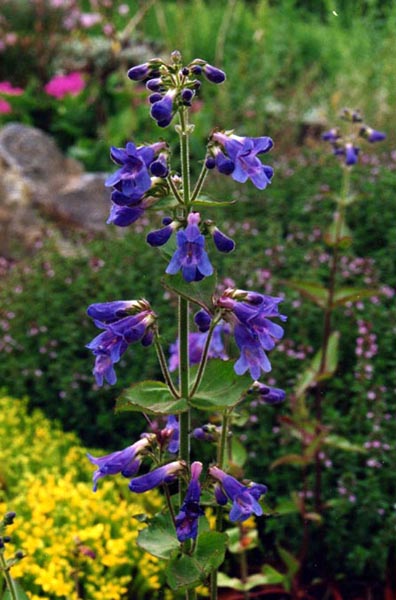
Perennial of the Plantaginaceae family, Penstemon ovatus is native to the northwest of North America, from British Columbia to Oregon and Idaho, where it occupies open meadows, forest edges, and grassy slopes, at low and medium altitude.
It is a medium to fairly large species for the genus, forming upright clumps of 50 to 80 cm in bloom. The stems are robust, slightly pubescent, bearing cauline leaves that are oval to oval-lanceolate, toothed, medium green, sessile, and often slightly clasping the stem. The basal foliage is petiolate. The whole plant is noticeably more herbaceous and less woody than many rock garden penstemons.
The flowers are tubular-bilabiate, an intense blue-violet to blue-purple, grouped in well-stuffed whorls along the stem. The flower buds are dark, almost navy blue, which enhances the chromatic intensity of the cluster as it opens. The clear blue color of this species is one of the most sustained in the genus.
In its natural habitat, its flowering extends from May to July. In cultivation, it generally occurs in June.
It accepts ordinary well-drained to moderately fresh soils, in full sun or very light partial shade. More accommodating than many penstemons, it is suitable for perennial beds as well as large rock gardens, and readily reseeds itself.