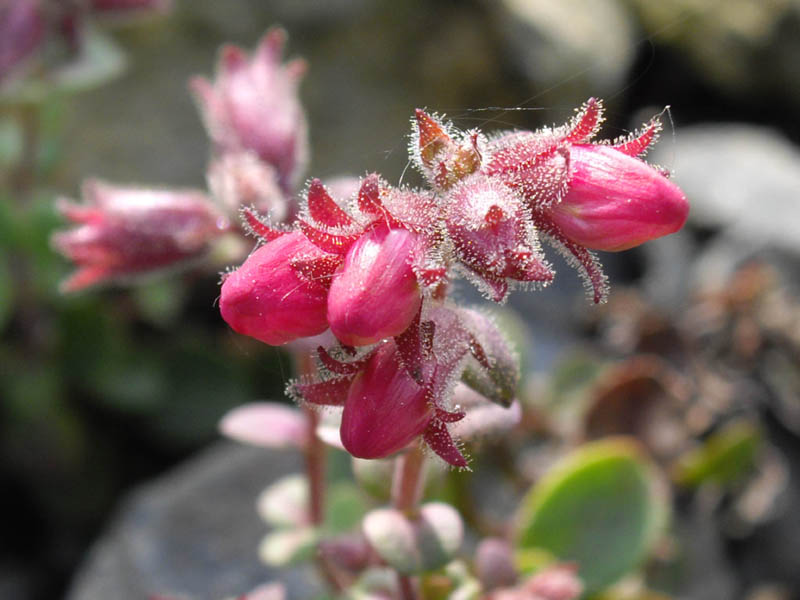
The plant spreads in creeping, woody stems at the base, barely exceeding 15 to 20 cm in height, capable of covering large rocky surfaces. The small oval leaves, finely toothed, often take on reddish hues on the margins and young shoots. The tubular flowers, of an intense magenta-pink, are borne in unilateral clusters along upright stems; the sepals and pedicels are densely covered with glandular hairs clearly visible under a magnifying glass, a distinctive feature of the species.
In its natural habitat, its flowering extends from June to August depending on the altitude. In cultivation, it generally occurs in May-June.
It requires excellent drainage, full sun exposure, and poor, mineral soil. Protection against stagnant winter moisture is crucial for its longevity in cultivation. The rock garden built on a slope or the retaining wall offers it the best conditions.