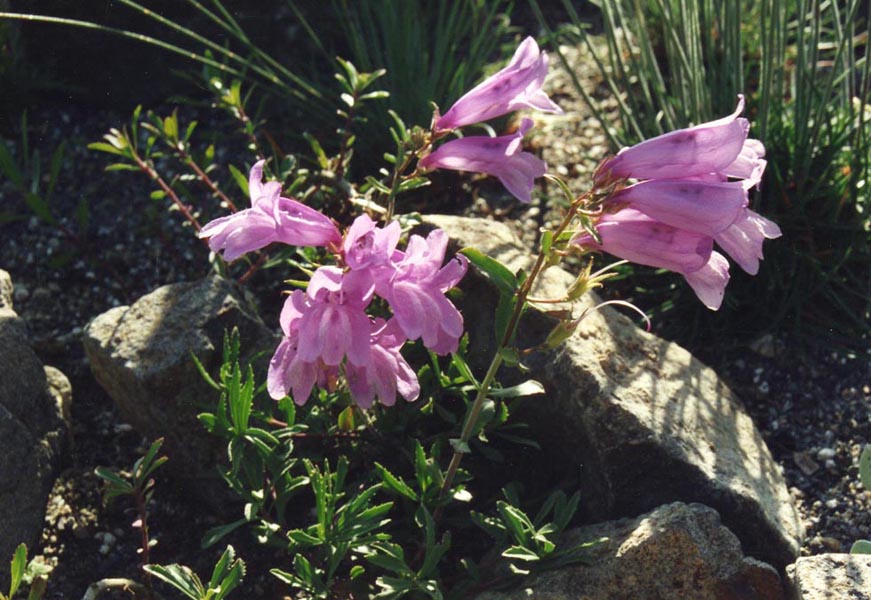
Woody perennial of the Plantaginaceae family, Penstemon fruticosus is native to the western part of North America, the Rockies and the interior ranges, from Montana to British Columbia and Oregon. It colonizes rocky slopes, scree, and cliff fissures, generally between 1,000 and 2,500 meters, on well-drained, often acidic substrates.
The plant forms a low, spreading shrub, woody at the base, 20 to 40 cm in height, with numerous stems adorned with small, narrowly lanceolate to linear, dark green leaves, slightly toothed, evergreen or semi-evergreen. This dense and fine foliage gives it a compact and bushy appearance even when not in bloom.
The flowers are tubular-bilabiate, large for the size of the plant, a delicate lilac pink to lavender pink, borne in loose clusters at the top of the stems. The two lips are well open, giving the flowers a remarkable breadth. The visible presence of the sterile stamen, or staminode, inside the corolla is a typical characteristic of the genus.
In its natural habitat, its flowering extends from May to July depending on the altitude. In cultivation, it generally occurs in May-June.
It requires well-drained soil, slightly acidic to neutral, poor to moderately fertile, in full sun. Hardy and relatively accommodating among woody penstemons, it is suitable for rock gardens, walls, and gravel gardens.