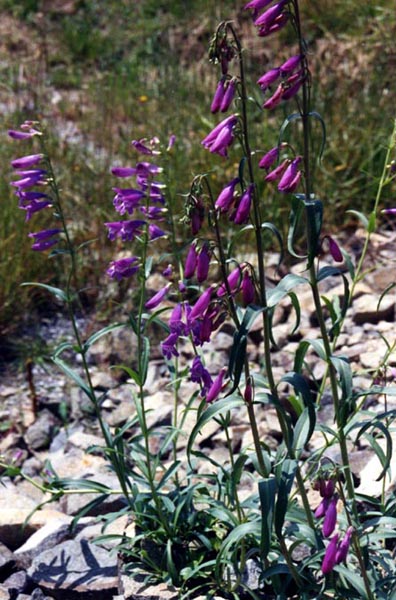
Perennial of the Plantaginaceae family, Penstemon alpinus is native to the Rockies, where it colonizes rocky slopes, high-altitude meadows, and limestone screes, primarily between 2,000 and 3,500 meters, from Wyoming to New Mexico.
The plant forms upright clumps of glaucous to bluish-green foliage, bearing slender flowering stems that generally reach 30 to 50 cm in height. The cauline leaves are lanceolate, sessile, slightly leathery; their characteristic glaucous hue is one of the most immediately recognizable signs of the species, visible at first glance on the basal rosette.
The flowers, tubular-bilabiate, are gathered in dense unilateral clusters along the stems. Their color varies from bright blue to intense blue-violet, sometimes leaning towards purple depending on individuals and populations. The inside of the throat is streaked with paler lines guiding pollinators, mainly bumblebees.
In its natural habitat, its flowering extends from June to August depending on the altitude. In cultivation, it generally occurs in June-July.
It requires very well-drained soil, poor to moderately fertile, in full sun. Sensitive to stagnant moisture in winter, it thrives in rock gardens or elevated embankments. Once established, it tolerates summer drought well.