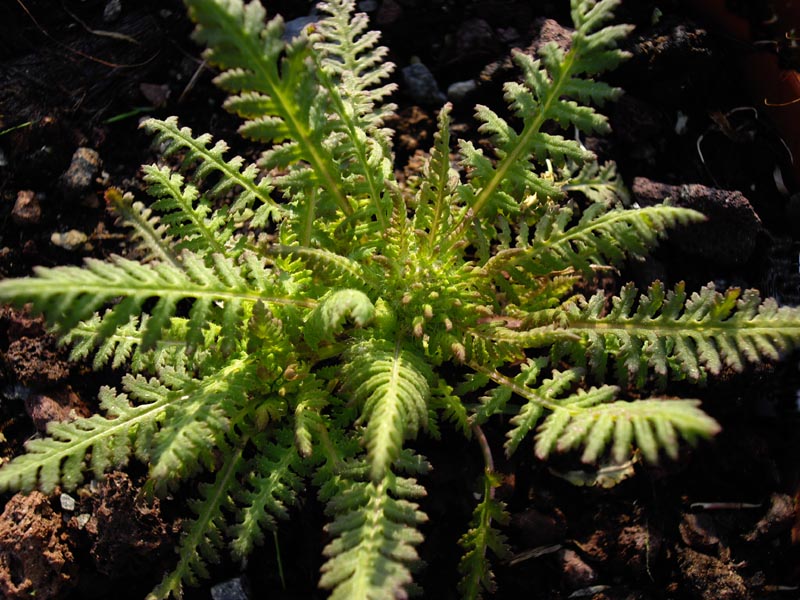
- in cultivation -
- in cultivation -
Perennial plant of the Orobanchaceae family, this species is native to the Himalayas, notably Nepal and Tibet, where it grows in moist alpine meadows and grassy slopes between approximately 3,000 and 4,500 meters in altitude. It belongs to a group of hemiparasitic plants, capable of connecting to the roots of other plants to supplement their nutrition.
It forms a sprawling basal rosette, almost flattened to the ground, from which erect floral stems emerge, generally reaching 10 to 20 cm in height. The foliage is finely cut, almost pinnatifid, light green, often slightly hairy, reminiscent in its delicacy of some alpine ferns.
The flowers are grouped in dense spikes, mixing soft pink to deeper pink tones. Each flower has a well-developed trilobed lower lip and an elongated brownish to pinkish hood, often curved, giving the inflorescence a unique and almost animal-like appearance. In its natural habitat, it blooms from June to August; in cultivation, it usually occurs in early summer.
A remarkable detail lies in the bristly appearance of the inflorescence, due to the deeply divided and ciliated bracts, which give the plant a very particular relief. In cultivation, it requires a humus-rich, fresh but drained soil, in a bright location without excessive heat. Its partially parasitic nature makes its cultivation delicate and often short-lived in artificial conditions.