Perennial of the Saxifragaceae family, the Marsh Parnassia is widely spread in the temperate and boreal regions of the northern hemisphere, from Western Europe to Central Asia and North America. It colonizes wet meadows, alkaline bogs, seepages, and stream banks, from the plains to the subalpine and alpine levels, reaching about 2,800 meters in the Alps and the Pyrenees.
The plant reaches 10 to 30 cm in height. It forms a basal rosette of heart-shaped leaves of a bright green, long-petioled. Each floral stem, solitary and upright, bears a single sessile clasping leaf and ends with a single flower.
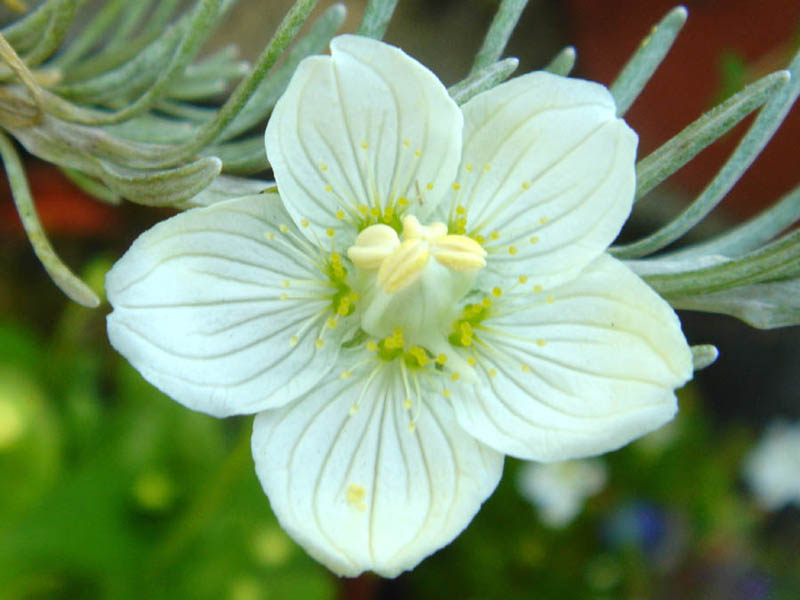
It is this flower that warrants all the attention. The five broad and rounded petals, of a slightly pearly white, are traversed by parallel green veins that give them an almost unreal luminous transparency. In the center, five sterile staminodes, each cut into fine strips whose ends bear small shiny yellow-green spheres, imitate with disturbing precision droplets of nectar to attract insects without feeding them. Five fertile stamens alternate with these staminodes, framing a central cream and stocky pistil. The whole forms a floral architecture of remarkable complexity and rigor for a flower of this size.
In its natural habitat, its flowering extends from July to September depending on the altitude. In cultivation, it generally blooms from July to August.
It is cultivated in constantly moist soil, rich in humus, preferably slightly calcareous, in full sun or partial shade.