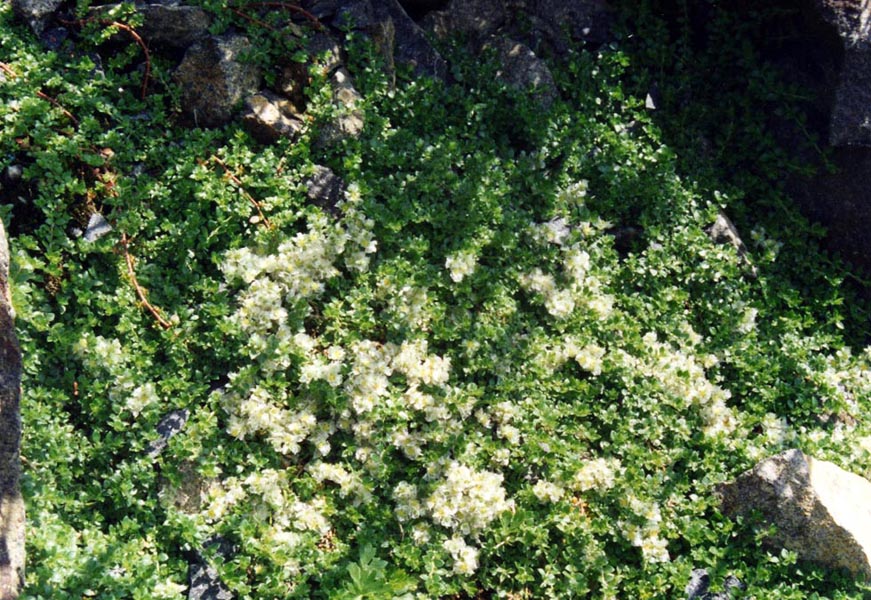
Perennial of the Caryophyllaceae family, found in the mountains of southern Europe, from the Pyrenees to the Alps and the Apennines, as well as in the massifs of the Iberian Peninsula. It is a mountain and subalpine plant found on rocks, slabs, stabilized scree, and rocky lawns, generally between 1,000 and 2,500 meters, on various substrates, calcareous or siliceous.
It forms creeping and spreading mats, with woody stems at the base, insinuating between stones and closely following the relief. The height barely exceeds 2 cm, but the spread can be considerable. The leaves are very small, oval, of a bright and fresh green, which pleasantly contrasts with the creamy white to pale greenish-yellow floral glomerules, borne in small dense clusters along the stems. The scarious bracts are present but less spectacular than in P. argentea, giving the flowers a more discreet and finely textured appearance.
In its natural habitat, flowering extends from June to August depending on the altitude. In cultivation, it generally occurs from May to July.
It requires perfect drainage, a poor mineral substrate, and full sun exposure. Robust and undemanding once established, it is perfectly suited to rock gardens, walls, and gravel gardens, where its stems gradually cover rocky surfaces with great discretion.