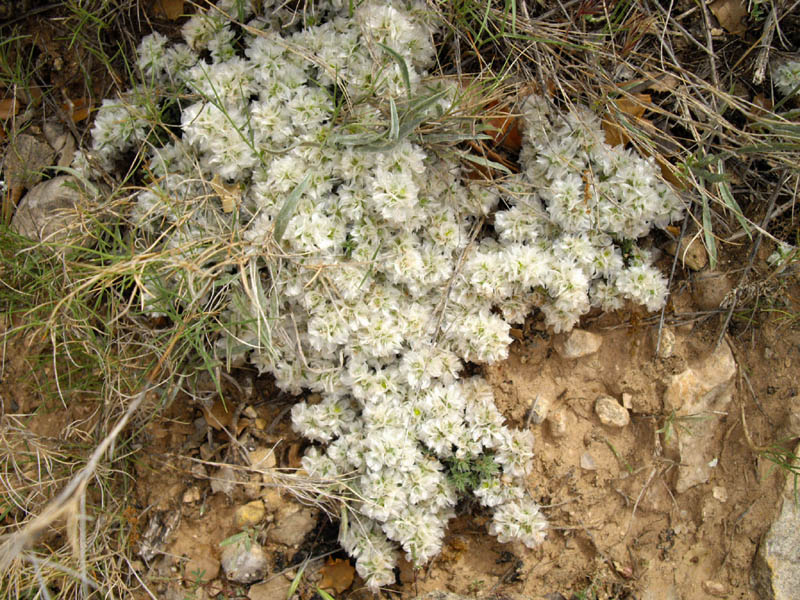
photographed in Spain
photographed in Spain
Perennial of the Caryophyllaceae family, described by De Candolle in 1828. Its distribution area is strictly Iberian, centered on the center and southeast of Spain, with some stations in northern Morocco. It occupies rocky grasslands, slabs, and limestone screes of the montane and subalpine levels.
It forms dense and compact cushions, barely exceeding 2 to 5 cm in height, with a tightly domed habit characteristic of the genus in arid high-altitude environments. The leaves are very small, narrow, and imbricated, of a grayish-green, almost entirely masked at flowering by the large silvery white scarious bracts that envelop the floral glomerules. This papery and shiny covering, which covers the entire cushion, constitutes the most striking feature of the species in the field.
In its natural habitat, flowering extends from May to July depending on the altitude.
In cultivation, it requires impeccable drainage, a lean mineral substrate, preferably limestone, and full sun exposure. It does not tolerate stagnant moisture in winter. Its compactness and visual effect make it a sought-after subject for alpine rock gardens and gravel gardens.