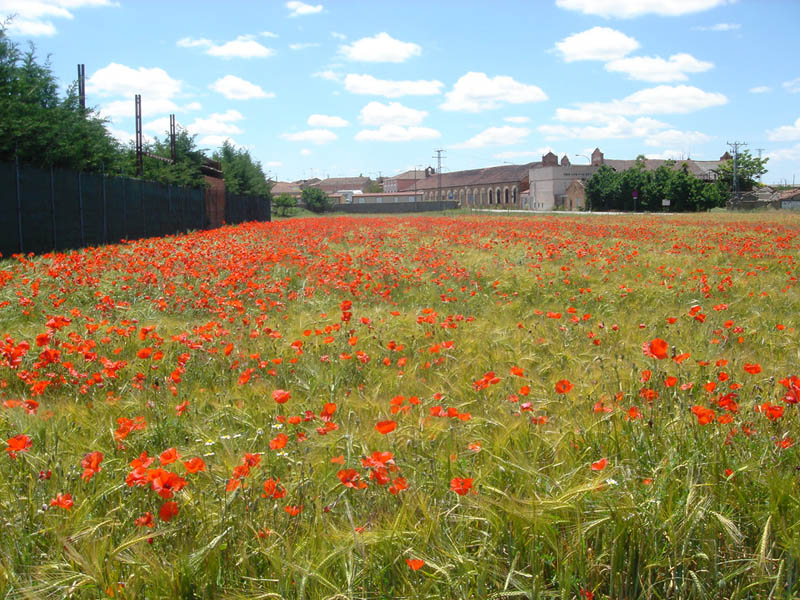
photographed in Spain
photographed in Spain
Annual of the Papaveraceae family, native to the Mediterranean basin and the Near East, now naturalized in much of temperate Europe and beyond. Plant of open and disturbed environments, it colonizes cereal fields, roadsides, wastelands, and embankments, on light, calcareous or loamy soils, in full sun.
It forms an upright and branched plant, generally between 30 and 60 cm in height, with stems and leaves covered with stiff spreading hairs. The leaves are deeply cut into toothed lobes. The buds, globular and densely hispid, are borne on long slender peduncles. The flowers, with four bright red petals often marked with a black basal spot, open crumpled then smooth out quickly; they last only two to three days. The stigma, a sessile radiating disc placed directly on the ovary, is a distinctive feature of the genus.
In its natural habitat, its flowering extends from May to July depending on latitude and altitude.
In Great Britain, the poppy has become since 1921 the symbol of remembrance for soldiers fallen in battle, in reference to the Flanders fields overrun with poppies after the battles of the First World War.
In cultivation, it is enough to sow in place in the autumn or early spring, on well-drained and sunny soil. It reseeds abundantly once established.