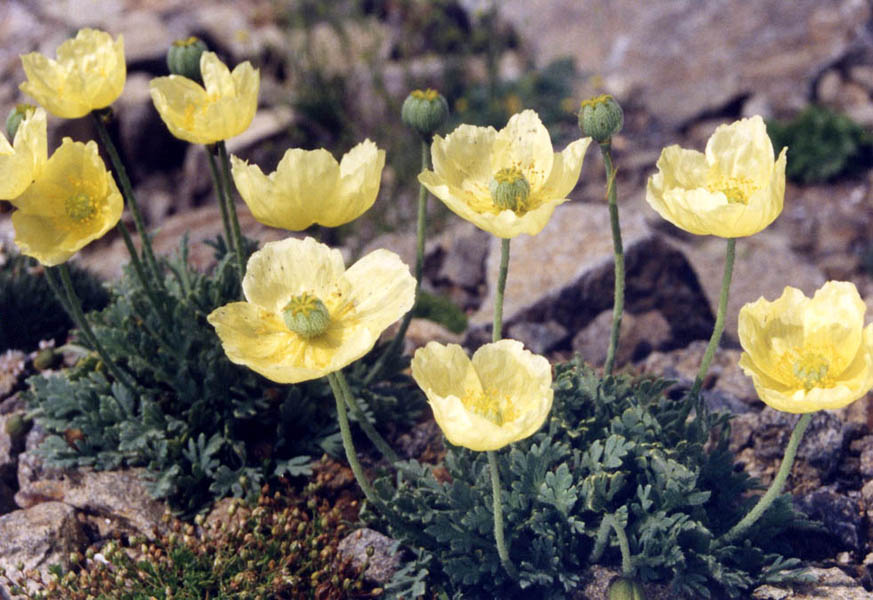
syn. Papaver miyabeanum
syn. Papaver miyabeanum
Short-lived perennial, sometimes treated as annual or biennial, of the Papaveraceae family, Papaver miyabeanum is native to Japan, where it is endemic to Sakhalin Island and the Kuril Islands. It grows in rocky screes, cliffs, and stony high-altitude terrains, in conditions of perfect drainage and prolonged sunlight.
It forms small, low, compact clumps, barely exceeding 15 to 20 cm in bloom. The foliage is very finely cut, gray-glaucous to blue-green, covered with soft hair giving it a downy and silvery appearance, immediately recognizable among alpine poppies.
The flowers, borne individually on slender, hairy stems, are a very pale sulfur yellow, almost cream, with four crumpled, broad, and delicate petals, surrounding a light green pistil and a cluster of yellow stamens. The buds are oval, covered with appressed hairs.
In its natural habitat, its flowering extends from June to August. In cultivation, it blooms generously from May to July and can self-seed spontaneously.
It requires a very well-drained, poor mineral soil, in full sun, with protection against stagnant winter moisture. It is cultivated in rock gardens, troughs, or screes and multiplies easily by seeding.