Short-lived perennial of the Papaveraceae family, Papaver alpinum is a species of scree and high-altitude rockeries of the Alps, Carpathians, and northern Apennines, between approximately 1,800 and 3,000 meters. Note: the taxonomy of this group remains debated; several subspecies and closely related taxa are recognized depending on the authors, and the flower color varies according to populations and massifs.
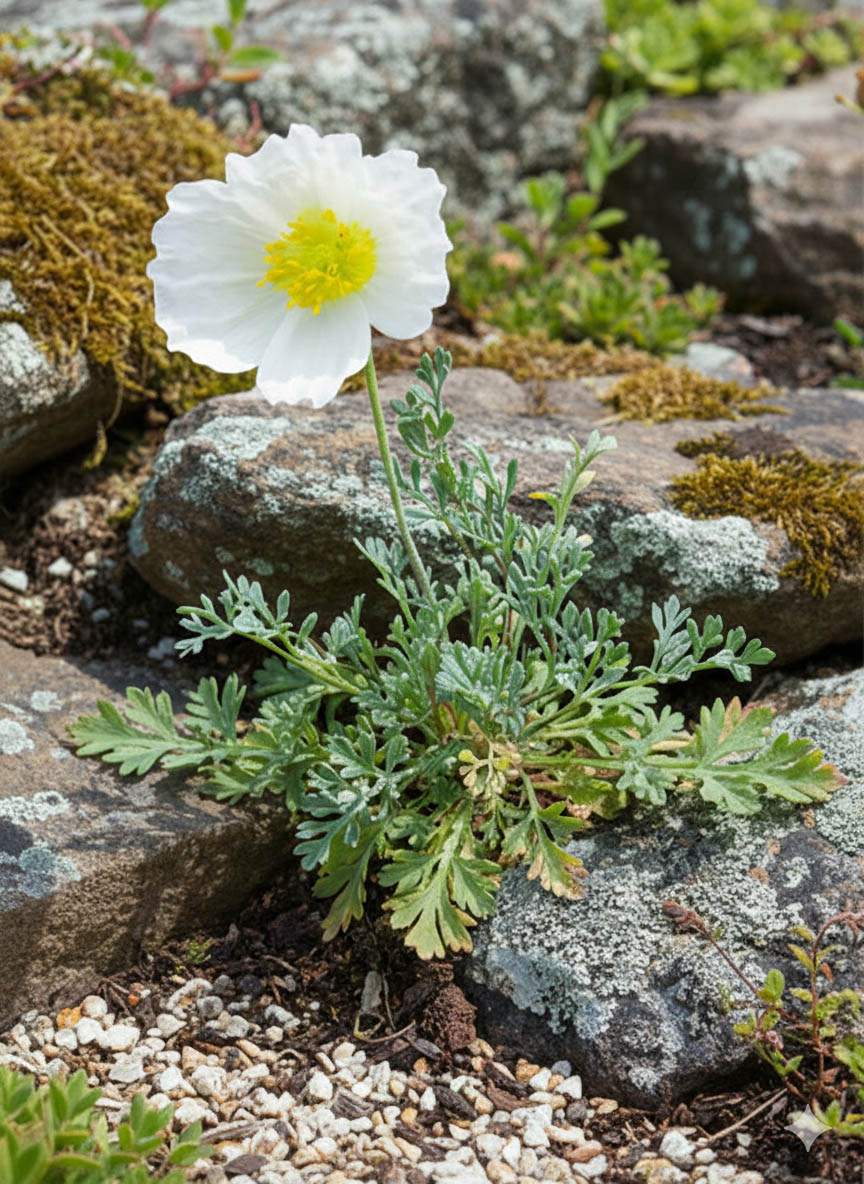
The basal rosette is particularly well visible here, pressed against the mineral substrate between the rocks. The foliage, finely divided into rounded lobes, has a fairly dense silvery-gray indumentum that gives it an ashy hue distinct from forms with greener foliage. This hairiness is an adaptation to high-altitude conditions, limiting dehydration and protecting from intense radiation.
The flower, borne on a slender stem of 10 to 15 cm, is pure white, with four widely spread petals, slightly wavy at the edges, with a bright yellow stamen heart around the pale green star-shaped stigma. The contrast between the immaculate whiteness of the petals and the vividness of the center is one of the most striking aspects of this form.
In its natural habitat, its flowering extends from July to August depending on altitude and snow cover. In cultivation, it can bloom as early as June in low-altitude rockeries.
It requires a mineral, very well-drained soil, in full sun, and readily reseeds itself in the crevices between rocks. It does not divide or transplant easily; sowing in place remains the most reliable method of propagation.