syn. Papaver alpinum
syn. Papaver alpinum
Short-lived perennial, often behaving as a biennial or a monocarpic plant, of the Papaveraceae family. Papaver alpinum is a species of the central and southern European mountains, found in the Alps, the Carpathians, and the northern Apennines, generally between 1,800 and 3,000 meters altitude. Note: the taxonomy of this group is complex and several authors distinguish subspecies or close taxa; the name Papaver alpinum is retained here in the broad sense, as it is commonly used in horticulture.
It colonizes mobile screes, moraines, lapies, and high-altitude rockeries, on calcareous or siliceous substrates depending on the populations, always in open exposure and in very well-drained soils, often poor and unstable.
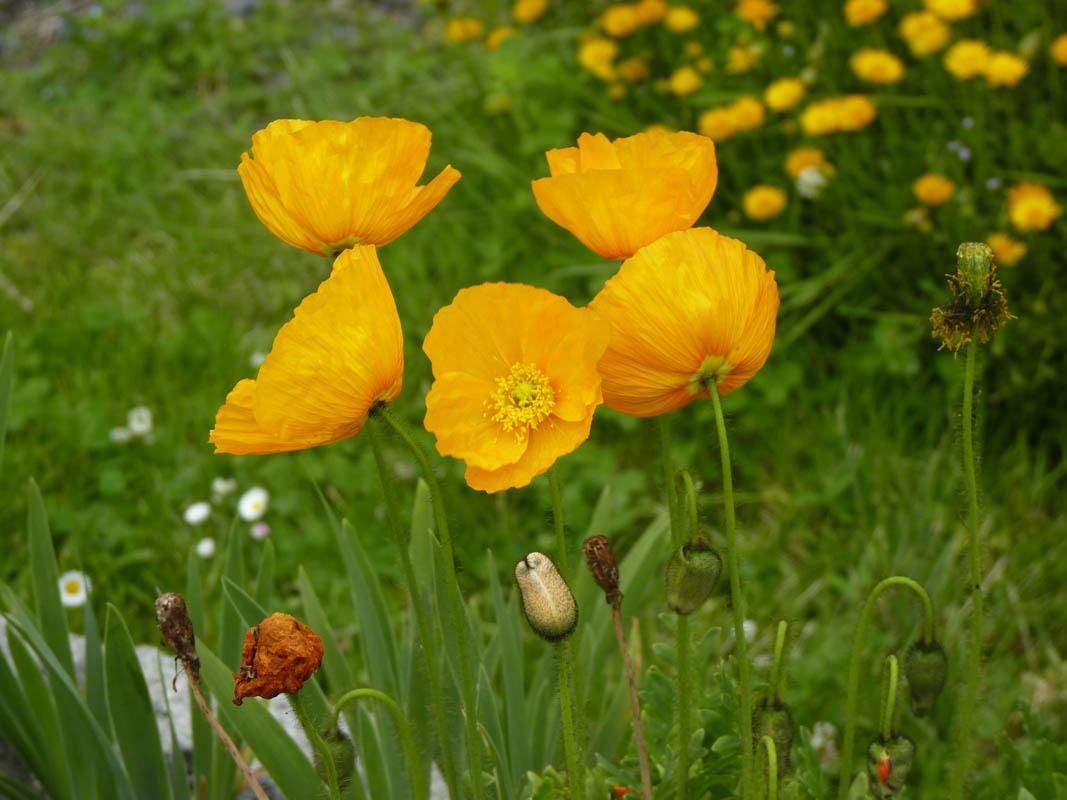
The plant forms small basal rosettes of finely cut leaves, gray-green to medium green, softly hairy, whose habit resembles finely chiseled moss. The slender, erect floral stems, 10 to 20 cm tall, each bear a nodding bud before anthesis — a typical characteristic of the genus — which straightens at opening. The flowers, with four large petals, crumpled like tissue paper, are bright yellow to orange depending on individuals and populations; the center is occupied by a pale green star-shaped stigma surrounded by numerous yellow stamens.
In its natural habitat, its flowering extends from July to August. In cultivation, it can bloom as early as June.
It self-seeds spontaneously with a certain generosity in well-drained rockeries, which compensates for its short individual longevity. Cultivation requires a mineral, very permeable soil, in full sun; it perfectly withstands winter cold but dreads stagnant moisture in any season. It does not transplant easily and is preferably sown in place.