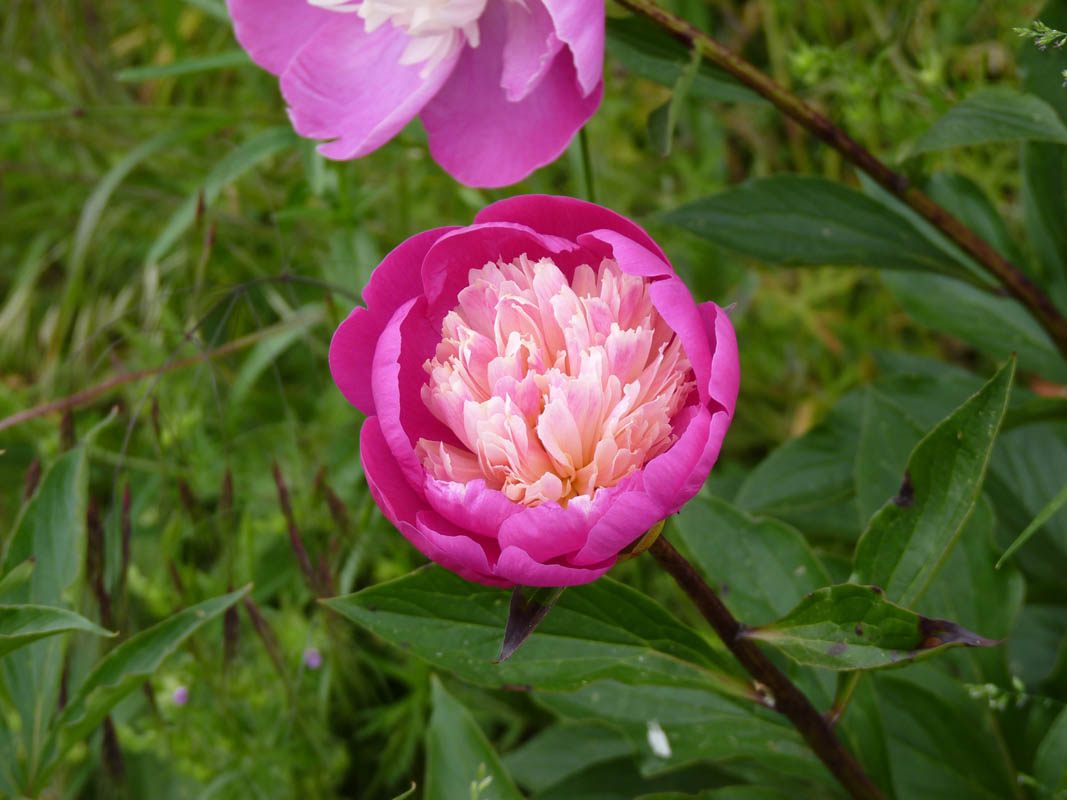
Perennials of the Ranunculaceae family, the herbaceous peonies cultivated in gardens are mainly derived from Paeonia lactiflora, a species native to Siberia, northern China, and Mongolia, to which have been added, over the course of selections, contributions from other wild Eurasian species. Horticultural selection, initiated in China over a millennium ago and intensified in Europe and North America in the 19th and 20th centuries, has produced several hundred cultivars with remarkably diverse flowers.
The plants form upright and voluminous clumps, disappearing entirely in winter, reaching 60 to 90 cm in height depending on the cultivars. The foliage is compound, divided into lanceolate to oval segments of a deep green, often tinged with reddish-brown at spring emergence. The robust stems, tinged with dark red, bear initially spherical buds, enveloped in colored sepals, which open into large flowers.
The diversity of floral forms is one of the most striking characteristics of the group. Traditionally, simple forms are distinguished, with a single row of wide, silky petals surrounding a mass of numerous, well-visible golden stamens — particularly accessible to pollinators —, semi-double forms, so-called Japanese or anemone forms with transformed staminode petals, and fully double forms, whose countless and tight petals form generous spheres or cups. The colors range from pure white to soft pink, bright pink, intense fuchsia pink, with some cultivars presenting a marked bicolor effect with deeply colored outer petals and a distinctly paler, cream or almost white heart.
In cultivation, flowering extends from May to June depending on the cultivars and climate, and can be prolonged by associating varieties of different earliness. The flowers often emit a pronounced fragrance, variable according to the cultivars, ranging from suave to powerful.
A characteristic detail of the genus is the frequent presence of ants on the flower buds, attracted by the extra-floral nectar secretions of the sepals; this association, often noted, is harmless to the plant. Peonies are renowned for their exceptional longevity — clumps several decades, even centuries old, are regularly reported in old gardens.
Cultivation requires a sunny to very slightly semi-shaded location, a deep, well-drained soil enriched with organic matter, neither too acidic nor too calcareous. Planting should be shallow, with the eyes (buds) placed two to five centimeters below the soil surface at most; too deep planting durably compromises flowering. Peonies tolerate winter cold well, which they need to bloom properly, and conversely do not tolerate too mild winters. Once established, they do not appreciate being moved.