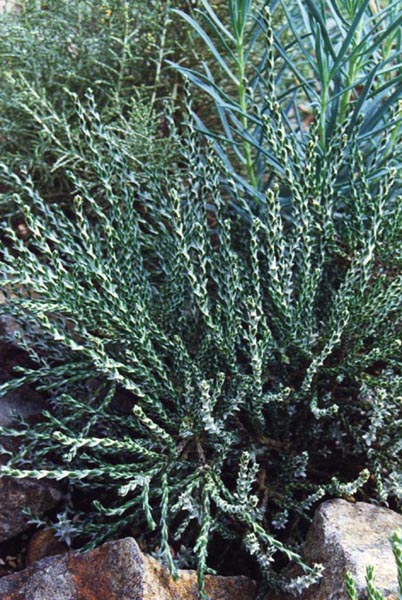
Dwarf shrub of the Asteraceae family, endemic to New Zealand, where the type species is present on both main islands on alpine ridges, screes, and very exposed rocky slopes, generally above 1,000 meters.
This variety forms a spreading to semi-erect shrub, dense and branched from the base, 15 to 30 cm in height, with rigid stems radiating from a compact center. Compared to the type form, the leaves are noticeably wider, as the epithet directly indicates. They are appressed against the stems in well-marked alternate rows, dark green and shiny on their outer face and distinctly whitish tomentose on the underside, creating a very characteristic contrasting bicolor effect, visible along the entire length of the stems.
This dark green and white contrast gives the branches a twisted and marbled appearance that immediately distinguishes this plant in a collection. The flower heads are small, whitish, in a terminal position. In its natural habitat, flowering extends from December to February.
In cultivation, it requires perfect drainage, a poor mineral substrate, full sun exposure, and good air circulation. Stagnant winter humidity is the main limiting factor in our latitudes; cultivation in a pot or under cold shelter is often preferable in oceanic regions.