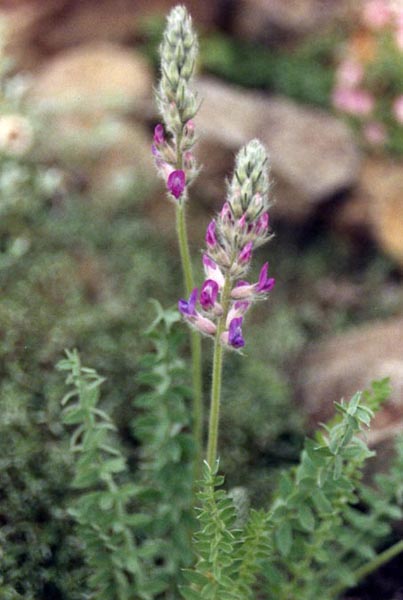
Perennial of the Fabaceae family, widespread in the mountainous regions of Eurasia, from the eastern Alps and Carpathians to Siberia and Central Asia. In Europe, it occupies dry alpine grasslands, rocky slopes, and poor meadows, generally between 1,500 and 2,800 meters.
It forms rather loose upright tufts, 15 to 20 cm in height. The foliage is one of its most immediately striking features: the leaves are pinnate, composed of numerous narrow leaflets arranged in close whorls along the rachis, and densely covered with silvery silky hairs that give the whole a frosted, almost luminous appearance.
The flowers are typically papilionaceous, of a fairly bright purple-violet, gathered in dense and elongated spikes borne by upright stems clearly exceeding the foliage. The still closed flower buds, wrapped in silvery silky bracts, form an almost cottony spike before anthesis.
In its natural habitat, its flowering extends from June to August depending on altitude and latitude.
Like most Oxytropis, it is reputed to be difficult to transplant due to a deep taproot system; it is preferably cultivated by sowing in place, in well-drained, poor soil, in full sun. It does not tolerate excess moisture or heavy soils.