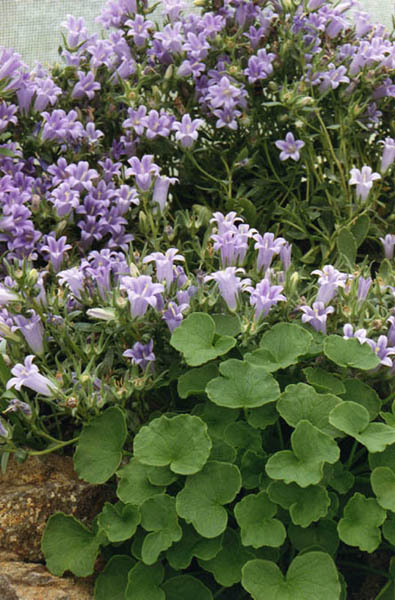
Oxyria digyna — Glacier sorrel. Perennial of the Polygonaceae family, circumpolar, present in all mountain ranges of the northern hemisphere, from the Alps and Pyrenees to the Arctic, passing through the Rockies and the Himalayas. It colonizes moist scree, snow hollows, stream banks, and seeping rocks, generally between 1,800 and 3,500 meters in altitude.
The plant forms small low tufts of 10 to 20 cm, with a loose habit. Its foliage is immediately recognizable: the leaves are kidney-shaped to almost round, long-stalked, of a tender green and slightly fleshy, very similar to those of a miniature sorrel. They contain oxalates, responsible for a characteristic tangy flavor, and were consumed by Arctic and Alpine populations for their vitamin C content.
The flowers are tiny, greenish to reddish, grouped in upright, not very spectacular clusters. It is mainly the fruits, bright red winged achenes at maturity, that give the plant its most notable visual appeal at the end of the season.
In its natural habitat, its flowering extends from July to August depending on the altitude.
In cultivation, it requires fresh, well-drained soil, in a semi-shaded exposure, and withstands harsh winters without difficulty. It is suitable for moist rock gardens and naturalistic alpine gardens.
Campanula saxatilis — Perennial of the Campanulaceae family, endemic to Crete, where it grows in the cracks of limestone rocks and cliffs, mainly in the mountainous massifs of the island, between approximately 600 and 1,800 meters.
It forms low and compact tufts, pressed against the substrate, 5 to 15 cm in height. The leaves are small, spatulate to oval, of a grayish-green, slightly leathery and often finely crenate on the edges, forming a characteristic dense rosette.
The flowers are open to flared bells, of a fairly pale blue-violet to lilac, borne by short upright stems emerging from the foliar cushion. They are grouped in small loose clusters, and their abundance relative to the size of the plant is striking.
In its natural habitat, its flowering extends from May to July depending on the altitude.
Like several campanulas of similar general appearance, it seems to behave as a monocarpic plant, giving its all to flowering before dying. It then perpetuates itself by spontaneous seeding. This characteristic, reported by experienced growers, invites leaving the seeds to develop and monitoring the seedlings at the foot of the mother plant.
In cultivation, it requires perfect drainage, a sunny exposure, and does not tolerate excess winter moisture. It thrives in dry rock gardens, wall crevices, or in pots under cold shelter in winter.